Showing posts with label purpose. Show all posts

Wednesday, April 12, 2017

Taking a Risk by Rethinking


The word I chose for 2017 is RISK. Now I haven't done many risky things lately. In fact, I'm not really sure what risky things I should be doing.

I've been thinking about making some videos related to homemade resources or repurposing stuff. While I'm not really all that photogenic, I think this would be something to risk that still fits within my personal purpose.

I've been dabbling in writing some fiction, which is a risk. Or will be whenever I make it available to others.


There are a few other things that I think could be a risk but nothing really firm or that seems to be eminent.

Until now. (That certainly sounds ominous.)


Recently I've been thinking about this blog. I love writing. I love thinking and reflecting on play and educating young children. But I've been busy with some other things and haven't been able to write as much as I'd like over the past month or so.

So I'm taking a risk. I'm rethinking what I'm doing here. I'm wondering what this space needs to be...or if this space needs to be. What changes do I need to make? What new things need to happen here? What needs to stop? To up the risk factor, I'm writing about it now.


For now, I'm still posting - maybe not as regularly as in the past. But I want to make sure that whatever happens here, it's intentional and purposeful and helpful to someone else.

What are you risking now? Or, if you chose a word for 2017, how is it playing out in your year? Let me know in the comments.

Friday, December 30, 2016

Thinking About 2016


As this year winds down, of course I reflect.

Here are a few stats from this year---

  • I completed 3 book studies for this blog, reading and reflecting through each one. (Well, I'll finish up the reflections on Free to Learn in the beginning of 2017.) 
  • I read a total of 54 books, both fiction and nonfiction. My goal was 60, so I'm a little shy of that, but I'm happy with that result. As I look over the list, it's definitely weighted with more fiction (and mostly mystery at that) but I did maintain my commitment to read a variety of books - history, business, education all in the mix.
  • My top post for 2016 had over 4000 hits - the post on chapter 1 of Free to Learn. Another post this year was over 3000 - a post about a school that had a "no live plants" rule. Wow! Very few of my posts have that many visits. It boggles the mind.

But reflection is more than just numbers or stats. I tried a few new things this year. I added quote/picture posts regularly. A new series (5 Ways to Use...) began. I worked to mix in posts about reflections, philosophy, and practical ideas. The focus of many posts became more about play and its importance in learning. 

One of my favorite posts grew from a frustrating experience I had. Accepting No is an important thought that was reinforced for me - kids can say no to things as well as yes.


And what about that one word for 2016 - PURPOSE? Well, I think there have been several things that have happened this year to make me think about my purpose. I may not be in a classroom daily but I'm still a teacher. Part of my purpose is to help boys and girls learn and grow. And I've found different ways to do that throughout the year. 

Here are a few specifics regarding PURPOSE that I'm thinking and reflecting on:
  • Drill down to a one sentence expression of your purpose. Choose a sentence that encompasses all you do...or can guide you to streamline what you do to fit that purpose.
  • Write it down. Regularly review it. 
  • When a new opportunity arises, test it against your purpose. That will help you decide what to do. Or it will help you refine your purpose sentence.
  • Your purpose should be bigger than your job. And, at least for me, the purpose focuses outward not inward on myself.

These are just a few things I've been thinking about regarding 2016. I'm looking forward to 2017. I have a few plans for it. I'm considering my new one word. I'm thinking about how this blog can adjust to help teachers and children. I'd welcome any input you have. If you have ideas about what you'd like to see here or what I could do better, please drop a note in the comments. 

Thank you for reading Brick by Brick. And thank you for whatever you do that helps boys and girls learn and grow.

Monday, October 17, 2016

Purpose: Sometimes It's Not What You Think

My word for 2016 is PURPOSE. This year I've been exploring what my purpose is and how I can work with purpose.


When I chose this word at the beginning of the year, I looked at my purpose statement as an early childhood educator. I looked at my philosophy of children and learning and how I could advocate and teach with that philosophy in mind.

However, when you focus on a particular word, interesting things happen. You may not seek out things related to that word, but things do come show up that are connected to it. I had become more attuned to the idea of purpose so many things seemed related to it.

I thought that I would look for ways to implement my purpose in a classroom. But I didn't teach regularly in a classroom. But I still had to think about purpose in my work - both in writing and in just being. I wanted to make intentional choices and think about how what I do connects with my philosophy and purpose.


So I created a purpose statement, a short statement that would encompass what I do: To glorify God and help boys and girls learn and grow. This statement helps guide what I do...in writing, in teaching, in working with others. Writing curriculum can help boys and girls learn and grow by helping teachers know how to teach. Reading about play and teaching develops my understanding and helps boys and girls learn. I can see how all the different things I do as a freelance writer and teacher is supported by one or both parts of this short statement.


And I think about the children in my church classroom. As they explore and work, sometimes the goal isn't what I think it is. They are just discovering the world. I think they may be exploring words or numbers. But they are doing something else entirely. I often impose my own thinking over what I see.

Just this week I watched a boy drawing. "Are you drawing a picture of something or just drawing?" I asked. "Just drawing," he said.

Then a pause. He smiled. "I can't wait to see if this is a Santa bag." (And I admit, the drawing did look like one.)

"You can't wait to see if your drawing is a Santa bag?" I asked. He nodded.

Later, when his drawing was complete, I asked, "Was it a Santa bag?"

"No," he said, "it was a pumpkin head face."

It was like the picture had a mind of its own. The child drawing had no control over the end result. And may that's what it was. He was drawing and exploring with shapes and colors and materials. And eventually something happens; something appears from the drawing and the child can name it.

I feel the same way about this year of purpose. I've been exploring and discovering. I see some images emerging through the process. But it continues to change and adjust as the year goes on.

I can't wait to see how it comes out in the end.

Friday, August 5, 2016

TLAP: The Often Missing Piece


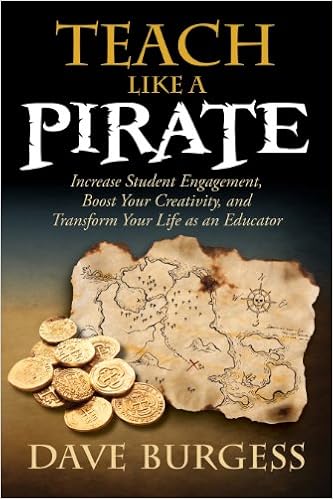
I am reading and reflecting on the book Teach Like a Pirate by Dave Burgess. The "pirate" philosophy is built on these things: Passion, Immersion, Rapport, Ask/Analyze, Transformation, and Enthusiasm.


The Third Circle


This chapter of Teach Like a Pirate begins Part II. Dave Burgess calls this section of the book the "toolbox" for a pirate teacher.

Effective teaching, he writes, happens in the overlapping circles of content, instructional strategies, and presentation. Most (if not all) teachers are experts in their content. Most have been effectively trained in using a variety of strategies. But often the missing piece is the third circle, presentation. Training programs and professional development seminars tend to overlook presentation methods and ways to engage students.

The book then uses what I think is a most effective metaphor. Focusing on content, giving it to students without purposefully thinking about how we present it, is the same as serving a raw steak to a dinner guest. Sure, you could choke down the raw steak but it will not be very enjoyable. We teachers often expect students just to choke down the content. We need to season and marinade the content. We need to apply some heat to it with energy and enthusiasm. We need to pay attention to the entire experience, not just force feeding facts or information.

Burgess stresses that we should create learning experiences that lead students to see education as exciting, amazing, fun...life changing. He writes: "[N]o content standard in any class at any level is more important than the nurturing and building a love of learning." Presentation, relationship, how we do things is as important (and maybe more) than what we're teaching.

I chose how the paper is oriented.

Then he hit me with a memorable thought. It sums up what I've been thinking for these past months. What he said that has been resonating with me since is in these three quotes:
  • "Everything you do or don't do [in teaching a lesson] is a choice."
  • "Some choices are major and others are minor, but even the minor decisions, when added up, create impact."
  • If you gave no thought to the matter, what's really going on is that you have abdicated responsibility for that decision."
Wow. If I can nothing else from this book, I want to hold on to this: What happens in the teaching experience is my choice. No music playing? I chose that (either purposely or by default). Dead space between transitions? My choice. Sitting too long? My choice. Too bright in the room? My choice. Either I didn't even consider it (which means I chose to go with whatever was there) or I chose it. Burgess says that we dampen the potential impact of a lesson by not consciously controlling all presentation factors. And all these factors (chosen or abdicated) woven together create the learning experience for the kids in my classroom.

Last year I read the book Teaching with Intention and tried to think about how to do things in an intentional way. This year I'm using PURPOSE as my word for the year, trying to make choices based on my personal purpose and mission. And now I think I see the summary of these ideas: Everything is a choice. 

I'm going to look at my classroom with more intention and purpose than ever. I'm choosing that lighting or background noise. I'm choosing that table arrangement or use of wall space. I'm choosing. So let's think about what are the best choices for the long lasting outcome.

Friday, June 3, 2016

Teaching on Purpose

My word for 2016 is PURPOSE. I've been trying to do and write and think in line with what I say I believe about children and learning. A key part of my personal philosophy is exploration, discovery, and self-directed play.


I've written about literacy play and math play that has occurred in my church kindergarten classroom. I've been pondering how practical this type of thinking and playing is in a general classroom.


Kids are naturally interested in words and letters and reading. Every child, at some level, wants to know more about these things. Some kids are naturally interested in words and will investigate them on their own.


Other kids are interested in other things. Words and books and reading become a conduit to knowing about those things.

Some kids love to use their hands and will explore letters in a more physical way.


Others want to interact with friends or adults. They will explore language as they talk and will explore writing and reading as more communal activity.


Kids want to express their ideas in tangible ways. They look for authentic writing and reading experiences - writing a note, telling a story, creating a map - through words or pictures or both.


They connect to words and letters that are meaningful to them - names, signs, logos. Using familiar groups of letters and symbols helps kids create meaning from text.


I look back when I taught first and second grades. I think then I let what "needed to be taught" overwhelm everything else. I discounted by own experiences and ideas. I wanted to do thing "right." But, purpose and philosophy still leaked in. We would play games with words and numbers. We would express ideas in words and pictures. We would investigate and follow ideas that the kids raised.


I would like to be in a daily school classroom again soon. I want to look for ways I could encourage exploration and self-directed activity in words and letters and numbers and symbols. To teach with purpose in mind, I want to be driven by what the children want to discover. They wonder and question. They are curious and adventurous. I want to be a partner rather than a leader in the classroom.

I hope I can teach on purpose.

Friday, March 25, 2016

Play Is Their Purpose


This year my word has been PURPOSE. I am intentionally thinking about what my purpose is and how what I do connects to it. What's my purpose? I'm advocating teaching young children as if they are young children. And that means play.


One of my favorite quotes of all time is from Rae Pica. She says that we shouldn't need to defend play for children. And we shouldn't.


But some adults look at children playing and see wasting time. They worry that children will not be ready for school or for the world of adulthood. They wonder if the children will have what they need later in life. What these adults do not see is that play is the way that prepares children. Play is the purpose of childhood. Play, as in experimenting and exploring and investigating. Play, as in doing something just to see what happens or just because it brings joy. Play is what's missing from school. Play is what's missing from adulthood.


When I worked in publishing, we were serious about what we were doing. We wanted to produce effective resources that helped teach boys and girls. We looked at what we were doing as an important calling.


But we had fun doing it. We told jokes. We pulled pranks (like rearranging or disarranging our manager's office while he was out - and he's very precise in where things go!). We had parties, planned and impromptu. We played. The times I remember things not going well are the times when things were too focused on work and play was squeezed out.


When I think about teaching first and second grades, the times I remember the most are the "play" ones. In a year that was very stressful and sometimes difficult, I can see that the times that were the most problematic were times I was focused too much on the work and not allowing any play. And usually those times were focused on what others thought or were imposing on us. We needed more play and less practice. What we usually got was less recess and more intervention.


In my church kindergarten class, I enjoy the more relaxed atmosphere. I am amazed at what my kid say and do. I watch them explore ideas and try out things. I watch them learn. Maybe not what I had planned for them to learn but what they have discovered through their play. They discover physics (force and motion and resistance) as they play with blocks and vehicles. They explore balance and symmetry and aesthetics. They explore how colors blend or how to create just the right design as they use paint or crayons or markers or paper scraps and glue. They explore how to negotiate or how to care as they play in the kitchen. They learn as they play.


Play is their purpose. It is our purpose. As I continue to make choices intentionally to support my personal purpose, I'm discovering more about an overall purpose. Play today and enjoy what you will learn, too.

Friday, February 19, 2016

The Most Dangerous Phrase?

This quote appeared in my Twitter feed again--

"The most dangerous phrase in the language is 'we've always done it this way.'"

I've seen that and heard that numerous times. Heck, I've probably even said it. After all, I've worked in a Baptist church and in a Baptist organization. And been involved in a Baptist church for most of my life. We're famous for that phrase.

But this time my response was "Oh, yeah. Really?"

Maybe I'm just being contrary. Or maybe I'm just tired. I worked through the night. Or maybe this is part of my current "ranty" phase. Or maybe it's because I'm thinking about purpose this year.

Because I'm thinking that an equally dangerous phrase is "Here's something we've never done before. Let's do that!"

Sometimes the way we've done it is that way for a reason. It's been tried and tested and proven reliable. Does that mean we should always do things the same way and never change? No!

But too often it's easy to see the shiny new thing and follow it. I think that's how we have gotten into some of these troubles in education. Bouncing from one method or idea or strategy to another. Without examining what works and what doesn't and why it does or doesn't and how we could make it happen again.

The most dangerous thing of all is unexamined practice.

I have my favorite practices and strategies to use in teaching. But I must continually examine what I'm doing. Is it effective? Does it accomplish what I want? Is it helping kids learn and grow and explore? (and play!) If it's not doing what I need, I must stop it. I must ask "What's my purpose?"

I have new things I am trying or want to try. But I must examine those, too. Will it help me accomplish the task? Is the investment (time, money, effort) worth the payoff? Does the benefit outweigh the cost? If not, I need to skip it (even if it's the hot new trend). Again, what's my purpose?

Some things always done before work. Keep doing them.
Some new things work. Start doing them.
Whatever doesn't work, stop or avoid.

Oh yeah, and next year (month, day), I'll need to think about it again. Kids change. Needs change. I change. And answers to those questions change.

The most dangerous phrase? "I doing what I want (old or new). Those kids are gonna need to adapt."

Friday, January 22, 2016

What Should They Be Learning?

In addition to starting to read The Power of Play, I am finishing reading the book Creative Schools by Dr. Ken Robinson. The book is a good discussion of issues that are facing educators today. Dr. Robinson includes some good thoughts about what schools should do (and provides some real-world examples of some of these things).

His discussion on curriculum was very interesting to me and still has me thinking. He lists eight competencies that schools should facilitate; what teachers do in the classroom should help students develop these competencies.

Curiosity – asking questions and exploring how the world works

airplane obstacles (Brick by Brick)

Creativity – generating ideas and practicing them

painting with oil (Brick by Brick)

Criticism – analyzing information, evaluating ideas, reasoning and forming arguments about these things

circle stamping faces (Brick by Brick)

Communication – expressing thoughts and feelings clearly through different media and in a variety of forms

communication table (Brick by Brick)

Collaboration – working constructively with others

floor board game (Brick by Brick)

Compassion – feeling empathy and acting on it

making a card (Brick by Brick)

Composure – developing a strong sense of self and creating balance within

rocking and feeding the doll (Brick by Brick)

Citizenship – engaging with society and participating successfully in it

cleaning the table (Brick by Brick)

I can see a place for all of these competencies in a preschool or kindergarten class (as well as a high school or college classroom). As I continue to think about how to act purposefully and intentionally, these competencies will come into play.

What do you think? Do you see these working in the curriculum you teach and the things you do in the classroom?

I haven’t quite finished Creative Schools. But it certainly is a thought-provoking book and fits nicely into all I’m thinking about at the present time.

Thursday, January 21, 2016

Purposeful Writing

My word for this year is PURPOSE. I've been thinking about what I do and why I do it. I've tried to write my blog posts and tweets and other efforts with intention, making them all support my overarching philosophy and purpose.

In doing that, I have been thinking about a lot of things. When I see an activity, I think about the why of that activity (why would I use it; what purpose does it serve). Since PLAY and exploration are key components of my philosophy, I've been looking at things and evaluating how they support the kids' ability to explore and play and use their own ideas.

This week we were thinking about our preschool leader in our church. She is celebrating a significant anniversary and we wanted to make something to thank her. I know there are all kinds of activities and crafts out there. We decided to make cards. We put out folded paper, markers, and gel pens.

writing and making cards (Brick by Brick)

I did print a couple of sentences that kids could use for writing. But this was their choice. They could write those words or not. They could write any message they chose (or not write anything).

writing and making cards (Brick by Brick)

I sat at the table with the kids as they worked. I talked about our leader and the things she does for us. We talked about when the kids saw her. I commented on what I saw kids doing. I read the "sample sentences" in case they wanted to write those words.

writing and making cards (Brick by Brick)

One girl asked me how to write "from." I wrote the word on the back of one of my sentences so she could write it on her card.

writing and making cards (Brick by Brick)

They experimented with shapes and colors. They found a few pens that no longer worked. When a pen began to write lighter and lighter, one girl said, "This is what you do." She shook it hard a few times. And it wrote darker again.

writing and making cards (Brick by Brick)

Classrooms all over our country are stressing academics and literacy. But I discovered my kindergartners working on purposeful writing. They wrote to express themselves and their gratefulness. (They may have used some of my words, but they chose those words as their own.) They saw how writing can communicate ideas and feelings. Pictures and words can tell someone we are thankful for what they do. Pictures and words can help show our happy feelings and cause happy feelings in someone else.

writing and making cards (Brick by Brick)

I wish all writing and literacy experiences could be purposeful and meaningful. My goal is to create an atmosphere that encourages literacy play and exploration. Now my church class is different (in purpose and context) from the children's school class. But playing with words - exploring writing and reading and communicating - is possible in all kinds of contexts.

My kids have shown me that making it purposeful makes it real. It makes it authentic. And that's when the learning (mental, social, emotional) really happens.

Friday, January 1, 2016

One Word for 2016

A few years ago, inspired by One Word 365, I began choosing one word to guide me for the year. Instead of resolutions or goals, I use this one word to help me focus for the year.

This past year has been one of learning and trying new things. I used the word YES as my guide. My reading impacted heavily as I thought about 2016 and one word to reflect and concentrate on. Reading Rae Pica's book has made me continue to think about child development and focusing on what I know about kids and how they learn. Reading Debbie Miller's book has challenged me to do things that are in line with what I believe. Both of these kept leading me to the word intentional.

But as I kept thinking about all I'm trying to do, I pivoted a little. My word for 2016 is PURPOSE.


This year I will hone statements about my personal educational philosophy and my purpose as a teacher and writer. What do I believe about teaching young kids? What's the purpose of my work, my blog, my life?

The things I write about, the things I tweet or pin, the projects I pursue - all of these will connect to my PURPOSE. I will be intentional--in my teaching, my working, and my life--in what I do in 2016.

Will that mean a change in what you see here? Not really. I will focus on using play and active teaching. I'll focus on preschool, kindergarten, and young kids. Those are things that I have always written about and advocated. But I will definitely be more intentional in what I'm doing.

I'm going to think about PURPOSE in 2016.

What you chosen a word for the year? What will be your focus?

HERE ARE THE POST FROM 2016 ABOUT MY WORD:

January: One Word for 2016: I'm going to focus on my purpose and be intentional
February: The Most Dangerous Phrase?: All strategies--new or old--should be examined
March: Play Is Their Purpose: Play is what children need; it's what we all need.
June: Teaching on Purpose: Can exploration be a part of literacy and math in the classroom?
October: Sometimes It's Not What You Think: Purpose can be evolving over time.
December: Thinking About 2016: Some things I've learned and am continuing to learn about purpose (plus a few other 2016 reflections).