Showing posts with label learning. Show all posts

Monday, May 21, 2018

A Little Autonomy

from If I Understood You, Would I Have This Look on My Face?

I've been reading the book If I Understood You, Would I Have This Look on My Face? by Alan Alda (yes that one). It's a book about communication, mainly his exploration of how to help scientists communicate their ideas more clearly with non-scientists. It's a great book about communication in general and I found many things that triggered my thinking as I thought about communicating with young children.

But the above quote definitely caught me. Play is all about giving the children some autonomy...and allowing them the joy of discovery. How can you give kids some autonomy, some say in what they are doing and learning? How can you give some independence? How can you recapture your own joy of discover?

Wednesday, September 20, 2017

Play Is the Way They Work

Play Is Way They Work quote (Brick by Brick)
from Purposeful Play by Kristine Mraz, Alison Porcelli, and Cheryl Tyler

The job of children is play. They do not need to be taught to play...or to learn for that matter. They are born doing it and it is their natural way to gain knowledge about the world around them.

Play is not the opposite of work. It is (and should be) intwined with work, the work of true education and learning.

Monday, September 4, 2017

Curse of Knowledge

Curse of Knowledge (Brick by Brick)
For more about the Curse of Knowledge, see Made to Stick by Chip and Dan Heath

Once you know, you cannot unknow. You cannot put yourself in the place of someone who doesn't have the knowledge that you have gained.

We build our knowledge and understanding upon what we've experienced plus insights (from those experiences). If kids haven't had experiences or built previous knowledge, they cannot understand. And they don't grasp understanding just because we've "explained" it.

Friday, September 1, 2017

The Thinking Behind the Knowing

Thinking Behind the Knowing (Brick by Brick)
On my bookshelf is a picture of one of my first grade friends. (Well, he's not in first grade now.) His picture is there to remind me of many things as a teacher. But recently it's been reminding me about learning, knowing, and what lies beneath it. 

It was a day in first grade that I will not forget. My student struggled to understand and I struggled to help. 

For a while in our math lessons, we had been practicing single digit addition. We were working on becoming fluent...at least some of us were working on that. Others of us were working on really understanding the concept of addition. I sat with my friend, working through some addition practice. We had worked through several addition problems until we hit a wall. My friend was struggling with adding zero.

I pointed to the problem (because, you know, pointing at it makes it so much more understandable). I asked: "What is 7 plus 0?"

My friend stared at it and then looked up at me with his large dark eyes: "8?" he asked in a voice full of hope.

Thus began our great odyssey. We drew pictures of the problem. He drew them; I drew them. We pulled out counters with the problem. He manipulated them; I manipulated them. We looked at a number line. We tried all kinds of different ways, creating visual and mental representations of the problem.

Counting quantities (Brick by Brick)

I heard the frustration and dismay in his voice. I felt my own frustration grow, frustration not at him but at my inability to help him. Each time his answer would be 8 or 9 or 10. I couldn't fatham what his thinking was and he couldn't voice it enough for me to know. Then a light dawned. I don't know what we were doing at this point, drawing or counting or what, but he sat up a little bit and said tentatively, "7?"

"Yes!" I said (hopefully not too loudly). I immediately wrote down another problem with 0 and we were at it again. A hesitant guess and then the correct one. We did several. We talked that adding 0 was easy because the quantity didn't change. My friend worked on through his math practice until it was time to do something else.

Of course, we reinforced the next day and so forth. But that's not the point of this story.

I sat thinking about my friend - at the end of that day and through other days. I talked with other teachers but they mostly just nodded and said that they were glad he got it.
Counting 10 mats (Brick by Brick)

Then...from somewhere...I got a thought. Every time we approached a problem with 0, his first guess would be a slightly higher number. (He did this every time until he got the "rule" about 0.) I wondered if he had developed an understanding about addition--that whenever you added, the answer would be a higher number. Was that the thinking behind his understanding of addition?

It makes sense; it's usually true, especially in kindergarten and first grade. Was his expectation that if there's a plus sign the number would go up? If so, no wonder he struggled with this 0 business.

I also thought about my frustration. And I was reminded about something I read in the book "Made to Stick" by Chip and Dan Heath. They write about the "Curse of Knowledge." Once you learn something it is impossible to put yourself in the mindset of someone who doesn't know it. It is impossible to think like someone who doesn't know. 

Roll and count game (Brick by Brick)

Sometimes I think we adults forget this as we teach and talk to young kids. We say something, explain something - and expect that they know it. We draw a logical conclusion because it's logical to us; we have lots of stuff in our head and the conclusion just makes sense. But those young children don't have all that stuff in their heads. They will believe us because we are the adults but they may not understand it. They may form an alternative understanding about it that makes sense to them - and that they'll have to unlearn later.

In our classrooms (both younger and older), let's think about what we are doing and saying. Let's listen more than we talk so we can understand what children know and how they are thinking. Let's not just assume that something is easily understandable because it makes sense to us. Let's remember that we cannot put ourselves completely in the new learner's shoes.

Let's encourage exploring and playing. Let's help children construct a real and true understanding of concepts. Let's help build the thinking that lies underneath the knowing.

Friday, February 3, 2017

Individualized Learning

A few recent experiences have me thinking about individualized learning. If you spend any time in the education sphere, you'll hear different phrases that express this idea--individualized learning, differentiated learning, personalized learning, focus on student needs. Now, before we go any further, I want to say that I'm all for this. In fact, I hope that every classroom at every level is thinking about a student's needs and how to help him or her succeed.

But I'm afraid that a lot of the methods "out there" give teachers and parents a false sense of actually meeting a child's need. Many times there's a heavy reliance on technology and software programs. This could be an effective way to help many kids and refine practice to focus on an individual's specific needs. But I think this is often as easy way to say we're providing individualized learning without really doing the hard work of providing individualized learning.

I love technology. While I'm not a part of the technology generation (translation: I'm old), I do try to keep up with what's going on. I'm willing to explore different ways to do things and I do not want to always do things the same way. However, I'm a little leery of claims that I just pull up a program, sit down kids at it, and they will get just what they need to build skills and progress.

A few years ago in the classroom, I was told practically this. We set up a new system; kids took assessments; kids would progress through their specifically designed lessons. I could get reports of how kids were doing. We only used it a few months (and then school was out), so I cannot give an accurate assessment of how effective this was. But I can say that I better understood what kids were doing and where they needed help when I sat down with them and watched them work or heard them talk about what they were doing.

The struggle I have: not all kids respond well to this type of practice or teaching method. Just like not all kids respond to doing a page of addition problems or work well in small groups or learn well by drawing pictures of the problem. One method does not fit all. Some kids need the motivation or extra support of someone sitting with them as they work. Some need to manipulate objects or touch things to make an understanding connection. I struggle with any method (technology based or not) that is billed as the way for all kids to progress or excel.

Well, any method except play. Offering a variety of materials and encouraging children to explore a skill, concept, or idea in their own ways is the best way for individualized learning (at least in my opinion). And "play" can include paper and pencil to work multiple math problems or write a story as well as blocks or paint or costumes. In my recent reading, I kept stumbling across the concept that in play, kids will explore whatever they need to learn. If we can introduce ideas and concepts, kids will explore them.

Individualized learning is more than just focusing on a child doing something by himself. It's more than looking at specific deficiencies (or strengths) and feeding practice to build or expand skills. It's really looking at children as unique persons - and finding ways to build on the natural excitement and curiosity that they have to know more about their world.

As a teacher, I'm not a tailor. I'm not measuring each child and creating a suit that fits him perfectly, individually. I should be interacting with the child and determining if he needs a suit or a parka or t-shirt and shorts. He doesn't need a closet of perfect fitting suits. He needs a wardrobe that fits who he is and where he is going.

I know that sounds idealistic, maybe a little naive, and even a little dumb. But it definitely sounds individualized to me.

Wednesday, January 18, 2017

Free to Learn: Final Reflections


Free to Learn by Peter Gray

"We do have a social obligation to provide rich educational opportunities for every child, regardless of his or her family background or income."


I finished reading Free to Learn a little while ago. And I've been pondering some of the things I read and I thought as I read. Here are a few general things that I'm still thinking about:

  • Children are capable of guiding their own learning. They understand themselves and will go as far as they feel comfortable but will limit themselves if they begin to feel incapable.
  • Left on their own, children will play and that play will be educational. They learn all the time, even if (or maybe I should say because) no adult is "teaching" them.
  • Play is play only when children have freedom--freedom to explore, freedom to change and adjust what they are doing, freedom to quit, freedom to ignore and do something else entirely.
  • The way we do school in most cases is not conducive to optimal learning. Lots of things that are inherent in the school culture oppose the way children learn most effectively.
  • Many adults do not have an appropriate view of the capability of children. They think children are more fragile and less able than they really are.
  • Children learn more from one another (of different ages and abilities) than they usually do from adults. They do learn from adults, but more from watching and mimicking than from listening.
  • Adults can be a resource and can offer help for children to make sense of what they are doing. 
  • If we want kids to be responsible, capable, helpful, cooperative, etc., we must allow them to practice these things on their own and in their own ways.
Most of these ideas are not completely new to me. Some things I knew have been affirmed. Some things I knew have been expanded and connected to other things. Some things have been challenged by meeting new information. 


But what I do know: we must not give up advocating for children to be a part of their own learning. Play is important. Play is who children are--children of all ages. We must determine how we can make children and school/education get on the same page. (And it's not the children that need to change.)

I enjoyed reading this book. Well, I liked it at first. Then I questioned it and where it was going. And then I ended up seeing the whole and agreeing with it on the whole. It's definitely added to my knowledge of children, learning, and play.


All the reading/reflecting for Free to Learn is on the book's page here on Brick by Brick.

Wednesday, January 11, 2017

Trusting Them with Their Own Development


Free to Learn by Peter Gray

Chapter 10 - Trustful Parenting in Our Modern World

"If you want responsible kids, you have to allow them the freedom to be responsible."


In this last chapter, Peter Gray focuses on parenting. He identifies three styles of parenting.

TRUSTFUL PARENTING: Parents trust children to play/explore on their own, make decisions, take risks, make mistakes, learn from their mistakes, and so forth. They do not direct the child's development since they trust the child to direct their own. This is not neglectful parenting; parents provide freedom with sustenance, love, respect, and support for development as needed.

DIRECTIVE-DOMINEERING PARENTING: Parents work to quash the child's will and replace it with a willingness to abide by the wills of others. This style is not very effective and has greatly diminished as a parenting approach.

DIRECTIVE-PROTECTIVE PARENTING: Parents limit the freedom of children because they fear for the safety of the children. They view children as fragile and incompetent. They believe they can make better decisions for the children than children can for themselves. They work to direct the child's development because they feel that adult plans are the best way for kids to develop.

Of course, Peter Gray advocates a trustful parenting approach. Trustful parents communicate to children: "You are competent. You know what you can do and what your limits are. Your opinions count. You are responsible for your own behavior and your own mistakes. We are with you, not against you."

But the North American culture overall greatly underestimates children's abilities and thus deprives them of opportunities to learn to control their own emotions and behavior. The decline of a more trustful approach is due to some changes in the world: decline of neighborhoods and neighborhood play groups so there are more restrictions to playing around the neighborhood; more culture of fear with media and "expert" warnings and dangers; desire to protect children from mistakes and own foolishness; view of childhood as time for resume building instead of playing (to have a more secure adult future); rise of school-centric model of development and the need to conform to mandatory school requirements. All of these can chip away the trustfulness that parents can have in their children.


Ways to become a more trustful parent (and I think these apply to teachers, too)

  • Examine values and how to apply them to children - How can you best build values of responsibility, honesty, self-initiative, etc.? Practice them as adults and help children practice them, too.
  • Accept that children need to take ownership of their own futures without adult control. Adults do not determine or set the child's future and should not shoulder the responsibility to direct the child's development. (This doesn't mean that we don't support development; we shouldn't try to direct it.)
  • Create safe spaces for play and exploration. Trust the child's ability to do his own activities and don't monitor too obsessively. Consider other alternatives to conventional schooling.
This trustful approach has me thinking. Rather than trying to develop differentiated learning experiences within the classroom environment, we should try to find ways to provide a broad space and materials for learning and allow children to direct that learning on their own. I'm reminded of Gray's discussion of the Sudbury Valley School environment. How can we create learning environments that allow children to take ownership for their own learning, responsibility for their own behavior, and ability to make mistakes and learn from them? Some big things to think.

I'll have one more final reflection post on Free to Learn. It's been an interesting read for me.

Friday, December 9, 2016

Freedom to Choose and Freedom to Use


As I read through Free to Learn, I keep finding words that explain my own thinking. Or at least Peter Gray has said things that I've always wanted to say but didn't really have the words to do so. One of those things that he has repeated in the chapters I've recently read is that play is freedom. He stresses the freedom to quit (to decide when to stop doing the activity). But I think that the freedom to use whatever resources are needed is important, too.

I'm a big advocate of children's creativity. I encourage children to follow their ideas and experiment with materials. And a few years ago, we adopted a "rule" to provide resources for a child when he asks for it, if possible. If a child asks me for tape or scissors (and those items are not already out in the room somewhere), I get them for him. I want to provide the tools for his creativity.

Often in my room, scissors, glue sticks, and paper scraps are always available if needed. I found some of those magnetic locker "baskets" (cheap at the back-to-school sale) and attached them to my white board. Kids can use these items whenever they choose; the resources are always at hand. (Not a new idea, I know. But it was a new step for us.)


I worried that I would be cleaning up paper bits each week from overuse of scissors. However, kids only use them when they really need them...which is not very frequently. And when they are used, the results can be surprising and amusing.


Since my room is used for a variety of other groups of various ages, I have to keep things easy to put out and take up. One day I hope to have a situation in which I can leave out more art supplies to be used as the child chooses. Until that day, I'll facilitate as much as possible...and enjoy the results.

But I'm learning that this availability issue isn't just art supplies. This year I have a boy that wants to use the cars often in the blocks center. The cars stay at my house unless I'm planning on using them. (We don't have the storage space to keep lots of supplies in the room.)


My friend has asked for the cars a couple of times and I bring them the next week. But recently I decided this wasn't enough. So I got a small container and filled it with some of our cars. I keep them in the cabinet in the room. When my friend asks for them, I pull them out for him to use.

Keeping scissors or cars available may seem inconsequential. But allowing kids the freedom to choose and the freedom to use what they want is huge. Following ideas through play and exploration helps children learn what they need to learn. (And when they need to learn it.) Don't dismiss engagement and high interest. Those can be the times that kids can learn the most (even if it's not what I planned for them to learn.)

Providing materials as requested also gives children some ownership in the learning environment and in the learning itself. And that's what we really want in the long run--children invested in their own developing understanding of the world. Those scissors or cars (or whatever) aren't just toys or materials - they are tools for exploration.

Kids should have the freedom to choose - and use - the tools they need and not just the tools I think they need.

Wednesday, November 30, 2016

Minimally Invasive Education


Free to Learn by Peter Gray

Chapter 6 - The Human Educative Instincts

"All animals learn, but only humans learn to a significant degree from others of their species and thereby creative, transmit, and build upon culture, from one generation to the next."


The title of this post is a phrase from Peter Gray: minimally invasive education, or education with minimal intrusion in the children's lives. That's what I often think when I think about teaching and learning in the early childhood environment. And it's a difficult balance - prompting or asking questions without intruding on what the children are exploring on their own. Gray would probably advocate only becoming involved at the child's direction. I sometimes think that a little question or push can expand thinking but ultimately I think kids should pursue their own agendas.

Peter Gray writes: "Today when most people think of education they think of schooling. In other words, they think of education as something done to children by adults." I would tend to agree. Gray writes about three innate aspects or instinctive drives within us that can serve education.

Curiosity - the drive to explore, understand, find out about the world around us. From earliest ages, children are intently interested in things they have not seen or experienced before, more than what they have seen or experienced already. As they grow, children are interested in exploring beyond what is known, not just replicating past experiences. If an adult explains how to use a toy, a child will explore it less and not discover much beyond what he was shown. If an adult just plays with the toy randomly and then gives it to the child or just gives it to the child without doing anything, children will explore the toy longer and discover more about its attributes. "Teaching" inhibits curiosity about the toy. Less direct instruction can yield more learning, deeper learning.

Playfulness - the drive to practice and create, to repeat new skills and use them in creative ways. Curiosity is focused on discovery. Playfulness is purposeful action to produce known result or using something in a different but purposeful way. Peter Gray lists several different types of universal play. (These types overlap and are not distinct categories.)

  • Physical play - using bodies in coordinated movements (running, wrestling, chasing)
  • Language play - learning to talk and use language to communicate (babbling, puns, rhymes)
  • Exploratory play - refining exploring skills (making sense of the world, science)
  • Constructive play - producing something that is in the mind (drawing, building)
  • Fantasy play - create and operate within an imaginary world (pretending, thinking logically)
  • Social play - cooperating and restraining impulses (playing games, negotiating)
All children play in these ways. Specifics of play vary from culture to culture.

Sociability - drive to share information and ideas, telling and teaching others what we know.
Children will naturally show others what they have learned. They will help other children discover how things work. Children learn more together than alone. Groups can generate more ideas and pool their knowledge to have greater understanding. Language is a key component to social learning.


Gray writes that schools thwart these natural instincts of children. They do not allow children to explore what they are interested in or make many choices related to what and how to learn/explore. Schools tend to focus on "one right answer" over finding ways to solve problems. Schools stress evaluation and assessment. Included in this chapter is a quote from a teacher; when students began to exploring items in a way different from what she had planned, she said, "Kids, I'll give you time to experiment at recess. Now it's time for science." (In other words, do things my way and explore on your own time.)

I think there's a lot of meat in this chapter regarding these three instincts. Peter Gray broadens the discussion of these three in the next chapters. But I think the note that adults and schools often thwart the natural ways kids learn is an important point. And I think the focus on standards can also tie the hands of educators who want to encourage exploration. The question I come back to is this: Are we derailing learning--true deep understanding and mastery--for education (performing well on tests and parroting back established formulas)? 

Friday, November 25, 2016

Subordinate Agenda

Read more about this in my post on EdWords

While I may think about activities and choose resources...while I may think about what will happen in the classroom...while I may see lots of possibilities for learning, my thinking and planning should take a backseat to the thinking and exploration of my kids. They will explore and experiment to make sense of the world and of their own ideas/thinking. I must be willing to relinquish control of the learning.


*(My friend used the cube blocks to spell PIXAR.)

Friday, October 28, 2016

Don't Get in the Way


I have lots of good ideas about what kids can do with materials. I have some fun plans for how things could be used. But I should never let my good ideas interfere with their great ones. Their curiosity and exploration lead to more learning that my ideas could.

Saturday, October 15, 2016

Pouring Not Building


I put out materials regularly with ideas of what I think will happen. Or what I think would stimulate thinking or exploring.

One day we put out the small cube blocks with our regular blocks. I added a couple of bowls to go with the activity.


One of our girls went over to the center and placed one cube in each bowl. She centered the cube in the bowl. Then she went away - off to explore elsewhere.


Later she came back to the center. (The other children were occupied elsewhere and left the blocks center alone.)

She poured all of the cubes into one of the bowls. The lone cube in the other bowl joined the rest.


Then she poured the cubes into the other bowl. She poured back and forth a couple of times.


Then she was off again to explore elsewhere.

No one else used the blocks. No one built anything. No one used the regular blocks.

But one girl explored what she needed to explore. Pouring not building. (The sound of the cubes falling into the bowl was pretty cool, too.)

That's what I enjoy about teaching young children. Their ideas are always evolving. They often surprise me about how they use materials.

They teach me what I need to know about learning.

Thursday, October 13, 2016

Self-Directed Play of an Old Culture


Free to Learn by Peter Gray


Chapter 2 - The Play-Filled Lives of Hunter-Gatherer Children

"The general belief among hunger-gatherer adults, borne out by centuries of experience, is that children educate themselves through their self-directed play and exploration."


In his second chapter, Peter Gray examines the culture of the hunter-gatherers--both in the past and more current groups. As with any culture, its values and norms impact the view of education and parenting. In this more primitive way of life, Gray seems to see the ideal for children and their learning.

The hunter-gatherers had three core values. Autonomy--every person (even a child) was free to make his own choices as long as his choices did not infringe upon another person's freedom or violate a societal taboo. Sharing--each person had a duty to share what he had (skills, possessions) with others as needed and to cooperate in obtaining food and defending the group. Equality--everyone's needs were equally important and no one was superior/inferior to another.

In this society, adults practiced what Gray calls "trustful parenting." They believed that children's instincts could be trusted, and children were allowed to follow their own way to learn what they needed to learn. Children explored freely and spent their time playing. And most of this play mimicked adults' actions. Children were allowed to use adult tools (knives, axes) since they needed to play with these things to gain skills in using them. Adults also created scaled down versions of other tools (bows and arrows, baskets) for children to use. If children asked about how to do something, adults showed them how to do it. Adults helped when asked but otherwise left children to explore as they chose. Adults were resources for the children's education but children were in control and directed their own learning. 

Adults believed that children would begin to contribute to the group when they were mature and skilled enough to do so. Children played until they were ready to be a part of adulthood. Children played at hunting and developed skills in tracking and making tools. They learned about animals' movements and habits. They learned about plants and how to process them for eating. Children would play in mixed age groups, with younger children learning from the experience of older ones. Mixed age play is more nurturing and less competitive.

"Hunter-gatherers seem to accept the twists and turns of fate and make the best of them, rather than complain." This culture has a greater capacity for self-control. Some research has indicated that play (self-directed play) is essential in helping the brain develop ways to control fear and anger in stressful situations. Perhaps the play of hunter-gatherer children contributed to the development of greater self-control in their adults.

Office Play (Brick by Brick)

Peter Gray thinks that today's societies could learn from the hunter-gatherer culture and bring some of their ways of education into today. (In fact, I think Peter Gray idealizes that older culture.) And I can see his point. I have seen the way that children mimic adults when they are engaged in pretend play. I see their desire to use real tools and to try out different roles. I have seen kids give freely of their own knowledge (or watch what someone with more experience does so they can learn).

I think a little more "trustful" approach to education would be helpful for children today. I think we should release the need to dictate what they should learn and how they should learn it. Of course, that means giving up some control. (Always tricky with us adults) And stopping all the assessment and grading. (I'd gladly see that go.) It particularly resonated with me when I read that adults were resources for education but allowed children to choose their own learning.

I'll be interested to see how this plays out through the book. After all, our culture is a little more complicated than the hunter-gatherers.

Monday, October 10, 2016

LIttle Learning Machines

Peter Gray quote (Brick by Brick)
from Free to Learn by Peter Gray

Children are ready to learn. We may get in the way by what we do.


(I'm reading and reflecting on Free to Learn this fall.)

Wednesday, September 21, 2016

Free to Learn

I'm starting a new book for reading and reflecting--Free to Learn by Peter Gray.

I've read some quotes and references to this book. And it must be popular because I had to wait to get it from the library.

I read the prologue - and decided that it is exactly the book for me to read.

Peter Gray writes, "Children come into the world burning to learn and genetically programmed with extraordinary capacities for learning. They are little learning machines." They learn to walk and run and move in all kinds of ways. They learn to understand what people are saying to them...and learn how to respond back in kind. They learn to use language to gain knowledge or express their own ideas. (They even learn to have their own ideas!) They engage with the world around them and absorb knowledge and skills through their interactions and play.

But, something happens along the way. He writes, "Nature does not turn off this enormous desire and capacity to learn when children turn five or six. We turn it off with our coercive system of schooling." The way we do school causes many (most? all?) kids to begin to dislike "learning."

Peter Gray's experiences with his own son affected him and his research. He began to explore learning and examine other types of schooling (such as un-schooling). He gained insights in using play and maintaining the "joys of childhood" was possible in the education process.

I'm looking forward to reading this book - seeing what he says and how it both supports and challenges my own ideas about play and learning.

Here's the line-up.

1 - What Have We Done to Childhood?
2 - The Play-Filled Lives of Hunter-Gatherer Children
3 - Why Schools Are What They Are: A Brief History of Education
   4 - Seven Sins of Our System of Forced Education
5 - Lessons from Sudbury Valley: Mother Nature Can Prevail in Modern Times
6 - The Human Educative Instincts
7 - The Playful State of Mind
8 - The Role of Play in Social and Emotional Development
9 - Free Age Mixing: A Key Ingredient for Children's Capacity for Self-Education
10 - Trustful Parenting in Our Modern World
Final Reflections

Saturday, September 17, 2016

A Class of Learning

Class I need quote (Brick by Brick)


Each year I get new opportunities to learn (as well as teach). What is this class of kids teaching me? What things work? What doesn't work? What do I need to change?

I can always learn more about teaching and learning...if I'm open to it.

Saturday, August 20, 2016

Expressing Thoughts

I was looking through my collection of photographs from my recent learning experiences with preschoolers and kindergartners. I came across this photo.


I obviously saw it when it was created because I took a photo of it. But I didn't ask the artist anything about it. I don't remember seeing it until I looked at the photograph. But it conjures up all kinds of questions.

What does it mean? What was the child thinking about or emulating when she created it? Was she working to understand the past versus the present? Old and new? Does she really know the meaning of "vs" or did she copy that from something else? What does it mean?

I cannot go and ask the artist now because there's no identifier on the art--I don't know who drew it. And even if I did, I doubt she would remember exactly the significance of the words and numerals and lines she drew. Or maybe she would.

As intriguing as I find this particular art piece, it reminds me that every line and letter that kids make on paper is significant. It is an exploration of ideas, an expressing of thoughts. Just as I ponder things here by typing and arranging words and sentences, kids ponder through swipes of a paintbrush or stroke of a crayon. They think; they ponder; they experiment; they express.

It seems that our schools are often hyper-focused on reading and writing and math. They stress academic performance on a narrow band of skills. They ignore (and even eliminate) art and music and creative expression. And yet, these means are may be the best way for kids to ponder and internalize important concepts and learning.

We had fun in our Art Camp this summer. And kids in my church classroom enjoy the opportunities to create from various supplies. But, as I see this picture and the others, I further realize that real thinking and learning happened then, too.

Don't forsake the crayons and paint. (Or the blocks and music and other creative endeavors.) These help kids think and express those thoughts.

And lead to some wonderful insights (even if we don't always know what those are ourselves).

Wednesday, July 27, 2016

Rushing Things

The other day I stopped into a local store to get some resources for an activity I'm planning. I saw a few craft items and kits for making Christmas ornaments or crafts. "Okay," I thought. "I guess you need to get started early on that kind of stuff."

Then I stumbled into an aisle that was row and row of Christmas ornaments. "It's July," I wrote later on Facebook."I don't need to see or think about this yet."

But, of course, I pondered on seeing all this Christmas stuff in July. It's seems that we're always rushing to the next thing. Maybe it's a product of our society or the need to be "productive" and "ready." But it seems that we are looking forward, pushing and preparing for what's next. And we miss out on what's now. I know we need to prepare and that things don't just happen without planning. But we can get so focused on what's coming that we miss the joys of warm (okay, hot) days and the smell of mown grass and the taste of cool iced tea. We don't need to rush on to Christmas in July.

And I thought about teaching young kids. Rushing things seems to be what we're all about in education. Kids need to read NOW. Kids need to master things NOW. We want them to be prepared for college and for life so we need to get things done when they're 5. We could discuss the wisdom of pushing young kids to read; I've read several things that say most kids aren't ready to master reading until at least age 7. We could discuss the more developmental needs that preschoolers have; Rae Pica has a great book on that. We could review the need for exploration and play and development of "soft skills"; many (including this blog) hit on those points regularly. All of those issues are very important and valid reasons for not rushing ahead.

But sometimes lost in all those important discussions is this: When we rush ahead, we miss the now. We miss the joy of being 4 or 5 years old. We miss silly jokes and sticky hands. We miss the deep questions that come when a young mind is beginning to pull strands of understanding into a more coherent whole. We miss the awe and wonder of looking at a trail of ants or the fun of punching holes in a piece of paper with a hole punch.

We miss experiencing life through the eyes of a young child. As an adult I've lost the ability to see things as new. A hole punch is just a tool. A stapler connects paper. Writing things down is a way for me to remember what my leaking brain may forget.

But when I experience a hole punch or a stapler or writing with a kindergartner, I see the miracles that these things really are. I experience joy.

And that's what we lose when we rush things. The joy of now.

Friday, July 15, 2016

Lazy Teacher

I tell people that I'm a lazy teacher - I never create more work for myself than necessary.

I think what I should really say is that I want to help children become more competent and self-sufficient. But, being a lazy teacher is certainly attention-getting.

Here are some ways that I've tried to help kids do things for themselves.

When I put out staplers or punches or other tools, we expect the children to do the things themselves. I will help them know what to do or how to use the item, but they do the work. (Okay, sometimes I press, too, to help the staple go through.)

punching holes (Brick by Brick)

If they want a picture of a horse or airplane or whatever, I do not draw it. They do. We place paper and other resources close at hand. If kids need something, they can get it for themselves. I do help move paintings from the easel (although they often want to do that for themselves, too). But the expectation is that the child will do the work. After all, how will they learn if they do not do it?


photo labels on drawers (Brick by Brick)

We expect kids to put away materials themselves. Now, maybe things stay out during the entire learning time. But when it's time to clean up and put things away, the kids are on the job. Since I've had my group of kindergartners in my church class for almost a whole year, I don't need to give them any guidance at this point. (Well, not much guidance.) They begin to pick up all materials. They carry the heavy block bin (two or three kids together) and put it in the cabinet. They pick up EVERYTHING and ask where it needs to go (if it's something we don't use every week).

We have labeled our drawers in the dramatic play center with pictures. Kids can see where things go, without being told or without having to try and figure it out.

small trash cans (Brick by Brick)

During the session, we want children to be responsible. We provide our small trash cans whenever we have stickers or other activities that generate trash. Anything that needs to be discarded goes in the small bins and then is later dumped into our large trash can. I don't need to think about what is trash; they take care of it.

cleaning the table (Brick by Brick)

If paint is dripped on the floor, I give them a wet paper towel or sponge. They clean it up. If we have a messy table after our activities, someone will help me wash the table down. Really. All it takes is for me to ask and they do it.

We do lots of other things and have lots of other expectations for kids to do the work themselves. And they want to do it - more times than not.
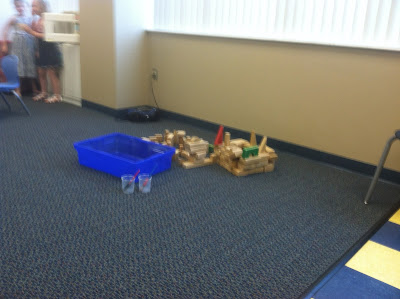
structure photographed by child (Brick by Brick)
His photo, not retouched at all

The other day one of my friends kept building and building. When he was done, he called me to see his structure. He wanted a picture of it. I gave him my phone (on the camera app) and said, "Here. Take a picture of your building. Press this button when you want to take the picture. He was a little reluctant. But he did it.

Of course, others wanted to take pictures, too. We passed the phone around and several kids took pictures.

One took this picture.

Mr. Scott, lazy teacher (Brick by Brick)

Me. Being a lazy teacher.

Or me. Helping them become more competent.

What do you do to help kids be self-sufficient?

Friday, July 1, 2016

What I Learned at Art Camp

Golf ball painting
What's Art Camp? It's a three-day (2 hours per day) event for 5 and 6 year olds (20 of them!). We had it at our church. Mrs. Cindy and I were in charge of it. This was the first time we've done it and we learned a lot.

We focused on types of art each day: Day 1 was Painting; Day 2 was Drawing and Stamping; Day 3 was Collage and Sculpture. Each day we had 10 art activities plus 1 activity outside. In our large group times, we talked about a Bible story and we talked about artists and what they do.

Drawing with chalk and spraying water
It was a busy and tiring time. And, from the feedback we heard, the kids had fun!

I'll blog about some of our activities later, but today I want to list a few things that I learned (or saw again) during Art Camp.

Drawing with pastels at the easel
1. Kids love to create. Given the opportunity, kids will make things - without being told or cajoled to do it.

2. Kids have their own ideas. Of course we had a "plan" for each activity, but often kids took the activity in their own directions. Either they created in ways we didn't expect or explored ideas in their art that were surprising or pulled items from several activities to create their own experience.

String painting
3. Kids love community. We had lots of fun talking about what we were doing or thinking about different kinds of art. They loved doing things together and interacting with one another. They used each other's ideas to expand their own thinking.

4. We had to be hands-on and hands-off at the same time. We had to give a little direction but let the kids so their own way. We had to be ready to provide materials and direct kids to get things themselves.

Fly swatter painting
5. Kids are open to new experiences and have no preconceived ideas. If I said we were going to paint with toothbrushes or draw around eyeballs or use hot glue guns, they were ready to go.

6. Process is king. Kids did enjoy having a end product to show their parents. But the real action was in the doing, not in the showing of the result. We punched holes and used staplers. We explored stamps and sticky notes. We looked in the mirror to paint self-portraits. We rolled golf balls with paint around a canvas. That was when the learning happened - when they were doing (and thinking!).

Slinky painting and foil transfer designs
7. My teacher voice is still alive and well. I heard myself giving parameters in a careful voice. I played movement games and told stories. I asked questions and listened to responses. Even though I don't use those classroom skills daily any more, it's nice to know they are still there.

Doing art is fun...and exhausting! I was more tired at the end of these three days than I was after five days of VBS. And I'll be ready for it again in about 362 days.

Drawing with charcoal pencils - complete the animal