Showing posts with label book study. Show all posts

Thursday, October 26, 2017

Keeping Play in Balance

This fall I'm reading Purposeful Play by Mraz, Porcelli, and Tyler. 


Chapter 2 - Balanced Play: How It Makes Kids' Lives Better

"For children, play is the furnace in which much of their brain development is forged."

This chapter covered a lot of material that I was already familiar with. What I like about this book is that it covers topics succinctly and pulls ideas from different sources in an easily understandable way. The authors cover different types of play and different stages of play - and while I have read about these types of ideas before, I enjoyed reading the treatment of them in this book. Let's look at some of those ideas.


As discussed in other books, the authors stress that play can be just about anything. Different individuals - children and adults - will see different things as play. What it comes down to is the motivation behind the activity. Was the activity self-chosen? Is the activity enjoyable (to the individual)? Can the activity be adapted at the will of the individual? If it fits these types of characteristics, the activity is play for the child or adult.

There are different kinds of play - and a child should have a balance of the different kinds. Kids explore different kinds of concepts and develop in different ways through fantasy/imaginative play, constructive play, games with rules, and rough-and-tumble play. (Check out more about different kinds of play, according to Peter Gray and David Elkind.) 


I really liked the different stages of play. This discussion made my think about the play continuum in terms of what is the child doing in relation to other children. 
  • Unoccupied behavior - watching others when something catches his interest but otherwise unengaged
  • Onlooker - deliberately watching others' play and perhaps asking questions about it
  • Solitary play - playing alone and totally absorbed in what he's doing; no interaction with others
  • Parallel play - playing with same materials as another child but doing his own play; may talk about what he's doing with others
  • Associative play - playing with others with same materials or in same activity; talk together about what they are doing but no planning; playing together but not working together
  • Cooperative play - playing together on common activity/project, forgoing individual goals for the group's goal
Seeing play as a continuum between individual action and group action is a new insight for me. And makes a lot of sense.


Here are three key quotes from this chapter that I want to remember:
  1. "There is often such a desire in schools to focus on what children need next that we forget what children need now." (I've said something similar...so I naturally agree!)
  2. "In all stages of play, children are refining what it means to create, innovate, explore, and develop into incredible human beings." (Play is key to development in all areas.)
  3. "Play allows children the means and the method to learn and adapt to a changing world." (Play is the natural way that children learn about the world.)

Tuesday, September 26, 2017

Play Isn't Just a Luxury

Reading Purposeful Play (Brick by Brick)
I have started reading a new book - Purposeful Play by Kristine Mraz, Alison Porcelli, and Cheryl Tyler. Vanessa at Pre-K Pages put me onto this book - and by the title it seems like just the book I need to be reading. So, let's get started!


Chapter 1 - Play Isn't a Luxury. It's a Necessity.

This first chapter made me nod throughout. Let's start with this quote:
"There is an argument in the world that suggests that play can happen only when work is done, yet children show us time and time again that play is the way they work."
 In their support of play, the authors show that play supports Common Core standards or any other standards that need to be addressed. Play is the child's own method of instruction - the way that children teach themselves. Teachers can use this child-directed method to teach all kinds of concepts and meet standards.

Punching Paper (Brick by Brick)


Rigor is another current educational focus. The authors say that play fits right into rigor...the true meaning of rigor, that is. "Because play is safe and familiar, children feel free to take risks and try on new learning." Children will push their learning to the edges of their ability, rigorously trying to master what they are doing.

Exploring Shape Patterns (Brick by Brick)


Another great quote:
"The thinking that occurs in play fits the definition of work (active engagement toward achieving a goal) and often provides impetus to continue working long after the official 'play' time is done."
I see more focus when children are exploring what they have chosen to pursue. The freedom to try and fail and try again encourage kids to push their ideas. Play allows children of different abilities and strengths to be successful...and to learn from others.

Spelling with cubes (Brick by Brick)


I've watched kids try something, observe others ideas, and attempt new things without any intervention or comment from me. I've heard kids use a wide range of words to express their thinking. Play is truly work - and rigorous work at that.

And that's just the first chapter of this book. I'm excited about reading further and learning more about how play helps children learn deeply.

Drawing on paper with eyes (Brick by Brick)

Reading and Reflecting: Purposeful Play

Fall 2017


Purposeful Play
by Kristine Mraz, Alison Porcelli, and Cheryl Tyler

SECTION I - ALL ABOUT PLAY: THE REASONS, RESEARCH, AND RESOURCES
Chapter 3: Creating Playful Environments

SECTION II - THE WORK IN PLAY: USING PLAY FOR SOCIAL AND EMOTIONAL GROWTH
Chapter 4: Caring Kids: Teaching Empathy Through Play
Chapter 5: Playing Together: Teaching Kids to Collaborate and Negotiate
Chapter 6: Play and a Growth Mindset

SECTION III - THE PLAY IN WORK: THE WHOLE DAY CAN FEEL PLAYFUL
Chapter 7: The Power of Tapping Into Student Interests
Chapter 8: Lighthearted Teaching: Supporting Meaningful Goals with Playful Tools and Charts
Chapter 9: Inquiry Is a Play Mindset: Learning How to Learn


Sunday, February 5, 2017

Bridging the Relationship Gap


This spring, I am participating in the "Beyond the Pages" book study on the book Bridging the Relationship Gap, led by Enhancing Young Minds.


You can participate, too. Check out the information on this online book study.

Each week Enhancing Young Minds will post a commentary on a chapter, written by a guest expert.

Read along and offer your insights, too. I'm interesting in learning more about building relationships and helping children thrive, even in the face of adversity.

The Book Chapters:

1 - How What We Feel Creates What We Know
2 - How What We Feel Builds the Brain
3 - How What Surrounds Us Changes Us
4 - How What We Experience Shapes Us
5 - When Those Who Love Us Hurt Us
6 - When Those Who Love Us Leave Us
7 - Reenvisioning the Response: Where We Go from Here

Wednesday, January 18, 2017

Free to Learn: Final Reflections


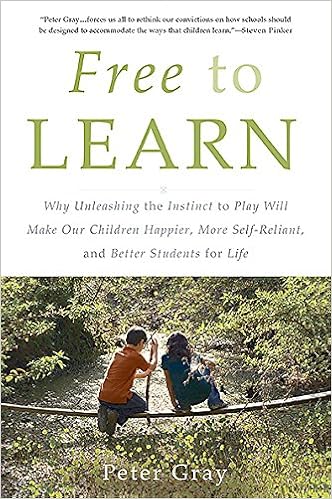
Free to Learn by Peter Gray

"We do have a social obligation to provide rich educational opportunities for every child, regardless of his or her family background or income."


I finished reading Free to Learn a little while ago. And I've been pondering some of the things I read and I thought as I read. Here are a few general things that I'm still thinking about:

  • Children are capable of guiding their own learning. They understand themselves and will go as far as they feel comfortable but will limit themselves if they begin to feel incapable.
  • Left on their own, children will play and that play will be educational. They learn all the time, even if (or maybe I should say because) no adult is "teaching" them.
  • Play is play only when children have freedom--freedom to explore, freedom to change and adjust what they are doing, freedom to quit, freedom to ignore and do something else entirely.
  • The way we do school in most cases is not conducive to optimal learning. Lots of things that are inherent in the school culture oppose the way children learn most effectively.
  • Many adults do not have an appropriate view of the capability of children. They think children are more fragile and less able than they really are.
  • Children learn more from one another (of different ages and abilities) than they usually do from adults. They do learn from adults, but more from watching and mimicking than from listening.
  • Adults can be a resource and can offer help for children to make sense of what they are doing. 
  • If we want kids to be responsible, capable, helpful, cooperative, etc., we must allow them to practice these things on their own and in their own ways.
Most of these ideas are not completely new to me. Some things I knew have been affirmed. Some things I knew have been expanded and connected to other things. Some things have been challenged by meeting new information. 


But what I do know: we must not give up advocating for children to be a part of their own learning. Play is important. Play is who children are--children of all ages. We must determine how we can make children and school/education get on the same page. (And it's not the children that need to change.)

I enjoyed reading this book. Well, I liked it at first. Then I questioned it and where it was going. And then I ended up seeing the whole and agreeing with it on the whole. It's definitely added to my knowledge of children, learning, and play.


All the reading/reflecting for Free to Learn is on the book's page here on Brick by Brick.

Wednesday, January 11, 2017

Trusting Them with Their Own Development


Free to Learn by Peter Gray

Chapter 10 - Trustful Parenting in Our Modern World

"If you want responsible kids, you have to allow them the freedom to be responsible."


In this last chapter, Peter Gray focuses on parenting. He identifies three styles of parenting.

TRUSTFUL PARENTING: Parents trust children to play/explore on their own, make decisions, take risks, make mistakes, learn from their mistakes, and so forth. They do not direct the child's development since they trust the child to direct their own. This is not neglectful parenting; parents provide freedom with sustenance, love, respect, and support for development as needed.

DIRECTIVE-DOMINEERING PARENTING: Parents work to quash the child's will and replace it with a willingness to abide by the wills of others. This style is not very effective and has greatly diminished as a parenting approach.

DIRECTIVE-PROTECTIVE PARENTING: Parents limit the freedom of children because they fear for the safety of the children. They view children as fragile and incompetent. They believe they can make better decisions for the children than children can for themselves. They work to direct the child's development because they feel that adult plans are the best way for kids to develop.

Of course, Peter Gray advocates a trustful parenting approach. Trustful parents communicate to children: "You are competent. You know what you can do and what your limits are. Your opinions count. You are responsible for your own behavior and your own mistakes. We are with you, not against you."

But the North American culture overall greatly underestimates children's abilities and thus deprives them of opportunities to learn to control their own emotions and behavior. The decline of a more trustful approach is due to some changes in the world: decline of neighborhoods and neighborhood play groups so there are more restrictions to playing around the neighborhood; more culture of fear with media and "expert" warnings and dangers; desire to protect children from mistakes and own foolishness; view of childhood as time for resume building instead of playing (to have a more secure adult future); rise of school-centric model of development and the need to conform to mandatory school requirements. All of these can chip away the trustfulness that parents can have in their children.


Ways to become a more trustful parent (and I think these apply to teachers, too)

  • Examine values and how to apply them to children - How can you best build values of responsibility, honesty, self-initiative, etc.? Practice them as adults and help children practice them, too.
  • Accept that children need to take ownership of their own futures without adult control. Adults do not determine or set the child's future and should not shoulder the responsibility to direct the child's development. (This doesn't mean that we don't support development; we shouldn't try to direct it.)
  • Create safe spaces for play and exploration. Trust the child's ability to do his own activities and don't monitor too obsessively. Consider other alternatives to conventional schooling.
This trustful approach has me thinking. Rather than trying to develop differentiated learning experiences within the classroom environment, we should try to find ways to provide a broad space and materials for learning and allow children to direct that learning on their own. I'm reminded of Gray's discussion of the Sudbury Valley School environment. How can we create learning environments that allow children to take ownership for their own learning, responsibility for their own behavior, and ability to make mistakes and learn from them? Some big things to think.

I'll have one more final reflection post on Free to Learn. It's been an interesting read for me.

Friday, December 30, 2016

Thinking About 2016


As this year winds down, of course I reflect.

Here are a few stats from this year---

  • I completed 3 book studies for this blog, reading and reflecting through each one. (Well, I'll finish up the reflections on Free to Learn in the beginning of 2017.) 
  • I read a total of 54 books, both fiction and nonfiction. My goal was 60, so I'm a little shy of that, but I'm happy with that result. As I look over the list, it's definitely weighted with more fiction (and mostly mystery at that) but I did maintain my commitment to read a variety of books - history, business, education all in the mix.
  • My top post for 2016 had over 4000 hits - the post on chapter 1 of Free to Learn. Another post this year was over 3000 - a post about a school that had a "no live plants" rule. Wow! Very few of my posts have that many visits. It boggles the mind.

But reflection is more than just numbers or stats. I tried a few new things this year. I added quote/picture posts regularly. A new series (5 Ways to Use...) began. I worked to mix in posts about reflections, philosophy, and practical ideas. The focus of many posts became more about play and its importance in learning. 

One of my favorite posts grew from a frustrating experience I had. Accepting No is an important thought that was reinforced for me - kids can say no to things as well as yes.


And what about that one word for 2016 - PURPOSE? Well, I think there have been several things that have happened this year to make me think about my purpose. I may not be in a classroom daily but I'm still a teacher. Part of my purpose is to help boys and girls learn and grow. And I've found different ways to do that throughout the year. 

Here are a few specifics regarding PURPOSE that I'm thinking and reflecting on:
  • Drill down to a one sentence expression of your purpose. Choose a sentence that encompasses all you do...or can guide you to streamline what you do to fit that purpose.
  • Write it down. Regularly review it. 
  • When a new opportunity arises, test it against your purpose. That will help you decide what to do. Or it will help you refine your purpose sentence.
  • Your purpose should be bigger than your job. And, at least for me, the purpose focuses outward not inward on myself.

These are just a few things I've been thinking about regarding 2016. I'm looking forward to 2017. I have a few plans for it. I'm considering my new one word. I'm thinking about how this blog can adjust to help teachers and children. I'd welcome any input you have. If you have ideas about what you'd like to see here or what I could do better, please drop a note in the comments. 

Thank you for reading Brick by Brick. And thank you for whatever you do that helps boys and girls learn and grow.

Tuesday, December 27, 2016

Let Them Mix It Up


Free to Learn by Peter Gray

Chapter 9 - Free Age Mixing: A Key Ingredient for Children's Capacity for Self-Education

"The free mingling of children who differ broadly in age is a key element to children's abilities to educate themselves successfully, on their own initiatives."


When we think of schools today, in fact usually when we think of activities or groups of children, we think of kids gathering with peers that are the same or close to the same age. According to Peter Gray, this segregation by age is a recent cultural phenomenon. In the past, kids interacted with siblings or available neighborhood kids; even in schools they were often taught or at least spent time with wider age spans. Today, in non-Western, non-schooled societies, age-mixing is common. As compulsory schooling expanded, kids were grouped more and more by age. Today children spend more time both in and out of school in settings with children the same age or within 1-2 years of their age. Kids have fewer places were they can freely mix with others of various ages.

And yet we know that kids learn by observing and interacting with others both older and younger than they are. This age mixing is beneficial to both younger and older kids.

For younger kids, they can participate in activities that would be too complex, difficult, or even dangerous for them to do on their own or with kids their own age. They learn from listening to the conversations of older kids and observing how they do things. They can operate more in their zone of proximal development--those activities that a child cannot do alone or with others of like ability but can do with someone more skilled. Often educators talk about adults helping kids achieve in the zone of proximal development, scaffolding (guiding/encouraging/reminding) their work. But these may work better in play situations with older children than with adults. "In age-mixed play, where abilities differ considerably, scaffolding occurs continuously and naturally, often unconsciously."

Younger children may engage in more literacy and numeracy play in mixed age groupings. They hear conversations of older kids and build vocabularies. They see the activities of older kids and incorporate that into their own behavior in self-determined ways. They build observation skills, skills that may not be fostered in traditional school situations. Younger kids also receive emotional support from older kids and develop meaningful relationships through their interactions.

While the value for younger kids are more obvious, free age mixing is beneficial to the older kids, too. They can practice leading others and learn how to function in a relationship. As they teach or talk about concepts with younger kids, they develop deeper understanding. Younger kids naturally engage in more creative activities and draw older kids into these types of experiences through their use of imaginations, pretend play, and materials to create. Older kids gain care and nurturing skills they will need as parents, caregivers, or leaders.

mixed ages in blocks (Brick by Brick)

All ages benefit from a freer exchange of ideas when ages mix. Younger kids may feel more free to ask questions or challenge ideas as they talk with older kids than when they talk with adults. Older kids may feel less threatened when their ideas are challenged and look for ways to clarify their thinking (than when ideas are challenged by adults). Also, free age mixing allows people of like abilities to interact. If a child is ahead or behind his age mates, he can find equal partners (regardless of age) in a mixed age environment.

I found this chapter very interesting. I think we naturally think of kids being in same age groupings today. But I've been in groups that include teenagers as "assistants" in the classroom and I've seen the mixing of these kids with preschoolers. And occasionally I've been in situations that have had wider age spans. I agree that younger kids will push themselves to keep up with the older ones. And the older ones take a nurturing interest in younger kids. This chapter has definitely given me some food for thought regarding how education could be enhanced or different with more mixing of ages. And I think that the final point - finding someone of similar ability regardless of age - is an important way we could offer some differentiation (without all the other things that tend to come with that word). I have more thinking to do as a result of this chapter. And that's good!

Monday, December 19, 2016

Taking Control of Their Lives


Free to Learn by Peter Gray

Chapter 8 - The Role of Play in Social and Emotional Development

"Play is how children learn to take control of their lives."


A large part of chapter 8 in Free to Learn contrasts informal sports play and games with adult-directed formal sports. (Spoiler alert: informal play seems to provide more benefits than formal game play) "Playing with other children, away from adults, is how children learn to make their own decisions, control their emotions and impulses, see from others' perspectives, negotiate differences with others, and make friends." Peter Gray pulls the ideas from this contrast into other areas of play--dramatic and pretend play, fighting play, risky play.

Here are some of the lessons that Peter Gray identifies as learned from informal sports play:

1. To keep the game going, you have to keep everyone happy. This means that play is adjusted to account for younger or more inexperienced players (and even adjusted for more experienced players, too). Since players have the freedom to quit, play is adjusted to allow for some success. Players see from others' perspectives and accommodate some of everyone's wants so the game will continue.

2. Rules are modifiable and player-generated. As conditions change, rules are adjusted.

3. Conflicts are settled by argument, negotiation, and compromise. The consensus of players decides parameters of the game, resolves disputes, imparts modifications. This doesn't necessarily mean complete agreement; everyone makes a decision to go along with a decision to keep the game going. (See lesson 1.)

"Kids playing sports informally are practicing many things at once, the least of which may be the sport itself."


4. There is no real difference between your team and the opposing team. "Opponent" is temporary and limited to the game. The team makeup changes from game to game (and sometimes within a game). In the end all are part of the same group.

5. Playing well and having fun are more important than winning. Stretching skills, enjoying the game, playing together - these are the goals of an informal game.

Children use play - pretend play and game play - to make sense of their environment, whatever that environment may be. They develop self-control, negotiation, compromise, empathy through play. Their play takes on what is happening around them so they can prepare themselves for what they will face as they get older.

"Dangerous" play is an important part of the child's experience. Kids will climb high, jump off things, perform tricks on playground equipment, play fight, and chase one another. This play has an element of risk and an element of fear to it. "In such play children must be in charge of their own activities, because only they know how to dose themselves with the right amount of fear." We often underestimate their ability to make good judgments about this type of play and to protect themselves during "risky" play.

I love Teacher Tom's writings about this topic. Many of his posts echo the idea that children know their own limits. They will push to their own edge and then pull back. But each time they are building confidence and skills to go a little further. (If you haven't read his post Brave, check it out.)

As I read this chapter, I was reminded of David Elkind's writing (in The Power of Play) that game play is learning to be a part of society. I think that Peter Gray makes some similar points here. But I think that one of the last points in the chapter was very telling. Peter Gray posits that the decline of empathy (connecting emotionally with others) and the rise of narcissism (inflated view of self) could be traced back to unsupervised, child-directed play with peers. Are we losing the give-and-take, consensus view of society because kids are not allowed to play freely anymore? It's certainly an interesting (and frightening) question to think about.

Wednesday, December 7, 2016

The Ideal State for Learning


Free to Learn by Peter Gray

Chapter 7 - The Playful State of Mind

"Learning, problem solving, and creativity are worsened by interventions that interfere with playfulness and inspired by interventions that promote playfulness."


This chapter focuses on play and playfulness, one of those key drives that Peter Gray introduced in the previous chapter. This chapter made me think and reinforced some of the things I've read and I already believe. It also made me think about things that I've done or advocated and evaluate them. Sometimes we adults label things as "play" when they really are not.

Peter Gray, in defining play, writes that play is more about motivation and attitude rather than a behavior. and its not a specific characteristic but a mix of several characteristics. These are the five characteristics to describe true and actual play.

Play is self chosen and self directed. Here I think we often may fall short when providing play experiences. In play, the children (or adults) have the freedom to choose all aspects of the experience. They choose what to do or not do. They choose when it begins and when it is done. If adults control it, it's not play. If children must participate, it's not play. If they can't choose to quit, it's not play. Often experiences are offered under the guise of play - but if the child isn't calling the shots (including the option to call it quits or ignore it altogether), it's really not play.

Play is motivated by means more than ends. "Play is an activity conducted for its own sake." If there's a required outcome, then it's not play. Kids may have goals while playing ("I'm going to build a hospital.") but this goal is subordinate to the actual doing. The real goal is the enjoyment of doing the activity not having the hospital or whatever at the end. "It is possible to ruin play by focusing attention too strongly on rewards or outcomes." The final result or a reward for completing the action cannot be the main reason/focus for doing it. When I read this, I wondered about the common practice now of posting outcomes and standards goals. If we stress "this is what we are learning" too much, does that take any enjoyment out of doing it? Are we converting everything to work?

Play is guided by mental rules. All play has a structure; self-imposed rules and parameters guide play. Kids exercise self-control and restraint when playing. They follow whatever the rules (formal or informal) have been established. The rules are modified from time to time, but all players must agree to the changes. As I've read in other books, these rules help a child begin to understand and become a part of society.

Play is imaginative. Play consists of real people and real props, but somehow exists outside the real world. This characteristic is most obvious in socio-dramatic play but is present in other play, too. "Through play the child learns to take charge of the world and not simply respond passively to it." This aspect of play can help develop abstract thinking, creativity, hypothetical speculation, and logical reasoning. Yet, often play is minimal in school, the place where this type of thinking needs to take place.

Play is conducted in an alert, active, but non-stressed frame of mind. Play requires active thinking not just passively responding to stimuli. Players focus on the process and have no real fear of failure. They risk. They have no stress of evaluation or condemnation. Mistakes are a part of the process. (Not really an atmosphere in most schools now.) Play is powerful because it is trivial; it is fun. Kids have the freedom to try impossible things with not judgments.


"When children are free to play, they play naturally at the ever-advancing edges of their mental or physical abilities." As they repeat an activity, they adjust slightly, gaining more information about what they are doing. They may repeat something exactly to master a skill. But usually there is a systematic adjustment of the action to explore it further. And when there is nothing left to learn or explore, children will move on to do something else.

I've been challenged by this chapter. It comes at a time when I've been growing increasingly in my thinking about the learning environment. I look for ways to say yes. I step back and follow the child's lead. I let them follow their own ideas and make choices. I welcome the times they choose not to do something. So maybe I'm allowing enough play to go on.

Just recently I took a box of cars to leave in my classroom. Because of my situation, many of my "extra" resources, i.e. the ones we're not using, stay at my home. But I have a boy that enjoys using the cars in the blocks center. He asks from time to time and I'll bring them the next time (if I remember). So now, I keep some cars in the room at all times. This week, when he asked, I was able to pull them out for him to use. Will this happen every week? I don't know. But now we have some available for when they are needed.

This chapter was a high point in this book for me. I like when I have ideas confirmed. I like when I have ideas expanded. And I like when I have ideas challenged. This chapter did all three for me.

Wednesday, November 30, 2016

Minimally Invasive Education


Free to Learn by Peter Gray

Chapter 6 - The Human Educative Instincts

"All animals learn, but only humans learn to a significant degree from others of their species and thereby creative, transmit, and build upon culture, from one generation to the next."


The title of this post is a phrase from Peter Gray: minimally invasive education, or education with minimal intrusion in the children's lives. That's what I often think when I think about teaching and learning in the early childhood environment. And it's a difficult balance - prompting or asking questions without intruding on what the children are exploring on their own. Gray would probably advocate only becoming involved at the child's direction. I sometimes think that a little question or push can expand thinking but ultimately I think kids should pursue their own agendas.

Peter Gray writes: "Today when most people think of education they think of schooling. In other words, they think of education as something done to children by adults." I would tend to agree. Gray writes about three innate aspects or instinctive drives within us that can serve education.

Curiosity - the drive to explore, understand, find out about the world around us. From earliest ages, children are intently interested in things they have not seen or experienced before, more than what they have seen or experienced already. As they grow, children are interested in exploring beyond what is known, not just replicating past experiences. If an adult explains how to use a toy, a child will explore it less and not discover much beyond what he was shown. If an adult just plays with the toy randomly and then gives it to the child or just gives it to the child without doing anything, children will explore the toy longer and discover more about its attributes. "Teaching" inhibits curiosity about the toy. Less direct instruction can yield more learning, deeper learning.

Playfulness - the drive to practice and create, to repeat new skills and use them in creative ways. Curiosity is focused on discovery. Playfulness is purposeful action to produce known result or using something in a different but purposeful way. Peter Gray lists several different types of universal play. (These types overlap and are not distinct categories.)

  • Physical play - using bodies in coordinated movements (running, wrestling, chasing)
  • Language play - learning to talk and use language to communicate (babbling, puns, rhymes)
  • Exploratory play - refining exploring skills (making sense of the world, science)
  • Constructive play - producing something that is in the mind (drawing, building)
  • Fantasy play - create and operate within an imaginary world (pretending, thinking logically)
  • Social play - cooperating and restraining impulses (playing games, negotiating)
All children play in these ways. Specifics of play vary from culture to culture.

Sociability - drive to share information and ideas, telling and teaching others what we know.
Children will naturally show others what they have learned. They will help other children discover how things work. Children learn more together than alone. Groups can generate more ideas and pool their knowledge to have greater understanding. Language is a key component to social learning.


Gray writes that schools thwart these natural instincts of children. They do not allow children to explore what they are interested in or make many choices related to what and how to learn/explore. Schools tend to focus on "one right answer" over finding ways to solve problems. Schools stress evaluation and assessment. Included in this chapter is a quote from a teacher; when students began to exploring items in a way different from what she had planned, she said, "Kids, I'll give you time to experiment at recess. Now it's time for science." (In other words, do things my way and explore on your own time.)

I think there's a lot of meat in this chapter regarding these three instincts. Peter Gray broadens the discussion of these three in the next chapters. But I think the note that adults and schools often thwart the natural ways kids learn is an important point. And I think the focus on standards can also tie the hands of educators who want to encourage exploration. The question I come back to is this: Are we derailing learning--true deep understanding and mastery--for education (performing well on tests and parroting back established formulas)? 

Tuesday, November 15, 2016

Children Educating Themselves


Free to Learn by Peter Gray

Chapter 5 - Lessons from Sudbury Valley: Mother Nature Can Prevail in Modern Times

"People naturally want to make sense of their world."


In chapter 5, Peter Gray explores the Sudbury Valley School, founded by Daniel Greenberg and others. Greenberg had wondered, "What is wrong with our educational system that prevents students from developing passionate interests and then pursuing those interests in their education?" He founded the school to create a democratic institution in which students could pursue their own interests and come to their own conclusions.

I found the description of this school very interesting. The school is administered by the School Meeting, with every person in the school (students and adults) having one vote in the proceedings. The meeting discussed and decided all rules of behavior, hiring decisions, budget and expenditure decisions, and so forth. The rules are enforced by a Judicial Committee comprised of student representatives and one staff member.

Students move freely throughout the grounds all day and associate with anyone they choose. Staff are adults that serve as resources and do other appropriate work (including ensuring safety and giving comfort as needed). Students can use whatever resources are available onsite as they choose - books, computers, equipment, adult staff, and one another. (Students must be "certified" to use expensive or dangerous equipment; they receive training as needed and show proficiency before they can use on their own.) Classes in specific subjects are offered at students' request and last as long as interest continues. Students older than 8 can leave the campus anytime; under 13 must be accompanied by another student and sign out. No set scheduled or set classes/subjects. Students are not grouped by age or in any other way (except as they choose). The school has no established curriculum, no testing, and no student ranking. If students want to receive a diploma, they prepare and defend a thesis explaining why they are ready to graduate and how they are prepare for responsible adult life; this is evaluated by outside reviewers.

"The basic premise of the school's educational philosophy is that each person is responsible for his or her own education."

Through this example, Peter Gray concludes that these conditions optimize children's abilities to educate themselves effectively--

  • Time and space to play and explore (unscheduled time, space to roam, choose for themselves)
  • Free age group mixing
  • Access to knowledgable and caring adults
  • Access to equipment and the freedom to play with it
  • Free exchange of ideas (all ideas are on the table)
  • Freedom from bullying (a safe environment)
  • Immersion in a democratic community

I'm very intrigued by the idea of the Sudbury Valley School. I agree with the basic premise that each person is responsible for his own education. I think that kids need more freedom to choose and pursue their own ideas and interests with less constraints. I think that many adults feel a need to exercise more control than they need to do.

I'm unsure that this philosophy could be replicated on a large scale throughout the country. But I do think that the education system could incorporate more of those conditions above and create environments that allow children to educate themselves more. I also think that we as a nation need to think about approaching education in some different ways, not just tweaking the existing system but creating a new one.

Kids want to explore their world. They are born ready to do it. We just need to find ways to get out of their paths.

Saturday, October 22, 2016

How Did Our Schools Get Here?


Free to Learn by Peter Gray

Chapter 3 - Why Schools Are What They Are
Chapter 4 - Seven Sins of Our System of Forced Education

"Children's instincts for self-directed learning can work today as well as they ever did."


Peter Gray offers a brief history of our educational system. He says that education and schools today are a product of our history. As cultures turned to agriculture, children were expected to do more work to support and help the family and had less time for self-directed exploration and play. Values within the system shifted to see work as more desired and play as wasteful use of time. Feudalism and industrialism created power structures from the top down and those in lower ranks were more dependent on the powerful. This was imparted to children as well.

Education grew from religious institutions, with the primary method of instruction as rote memorization. Hard work was emphasized and valued. "Learning was understood to be work, not play." Later the government took over education. "Schooling came to be seen as a state function that was essential for national security...", shaping future citizens. Education became compulsory and more standardized (in both content and method). These concepts of education continue down to the present-day. "We automatically think of learning as work, which children must be forced to do in special work places, schools, modeled after factories," writes Gray.

He lists seven sins of the system of compulsory ("forced") education:
  1. Denial of liberty without just cause and due process.
    (Should children be required to attend school?)
  2. Interference with the development of personal responsibility and self-direction.
    (We assume children are not able to be responsible for their own education due to their age. Schools do not allow children to self-direct their education or assume responsibility for it.)
  3. Undermining of intrinsic motivation to learn (turning learning into work).
    ("Anything a person is forced to do, according to someone else's schedule, using procedures that someone dictates, is work." Schools circumvent the child's natural tendencies to learn and explore.)
  4. Judging students in ways that foster shame, hubris, cynicism, and cheating.
    (Continual testing creates inferior and superior feelings in students; focus on grades and no real focus on actual learning; pressure to perform)
  5. Interference with the development of cooperation and promotion of bullying.
    (Schools force competitiveness on children and promote selfishness. Lack of age-mixed play discourages cooperative and nurturing among students.)
  6. Inhibition of critical thinking.
    (Grading is powerful force against honest debate and critical thought. Focus on correct answers to other's questions rather than own thoughts and questions. Increased anxiety inhibits playfulness and critical thinking.)
  7. Reduction in diversity of skills and knowledge.
    (On their own, children follow diverse paths and unpredictable connections in education; but in prescribed curriculum, no room is allowed for a child's own interests. Schools don't adjust to different personalities; they try to mold students to fit the system.)

These two chapters did provide some insights into our current approach to educating children. I agree that schools provide little in the way of diverse approaches to education. That goes for teachers, too. Sometimes it's hard for teachers to deviate much from the norm; the pressure to do it the "right" way is often very real. 

It seems that, in the current climate, the tendency is more standardization, more testing, more "work" for students. More hoops, more data, more directives for teachers. I have heard people say that we cannot fix our current system; the only way we can change what's happening is to start from scratch with a new system. That seems to be where Peter Gray is going, too.

I am interested to see where the book will be going next. Peter Gray certainly writes with a specific point of view...and I wonder how his view of things will align with my own.

Thursday, October 13, 2016

Self-Directed Play of an Old Culture


Free to Learn by Peter Gray


Chapter 2 - The Play-Filled Lives of Hunter-Gatherer Children

"The general belief among hunger-gatherer adults, borne out by centuries of experience, is that children educate themselves through their self-directed play and exploration."


In his second chapter, Peter Gray examines the culture of the hunter-gatherers--both in the past and more current groups. As with any culture, its values and norms impact the view of education and parenting. In this more primitive way of life, Gray seems to see the ideal for children and their learning.

The hunter-gatherers had three core values. Autonomy--every person (even a child) was free to make his own choices as long as his choices did not infringe upon another person's freedom or violate a societal taboo. Sharing--each person had a duty to share what he had (skills, possessions) with others as needed and to cooperate in obtaining food and defending the group. Equality--everyone's needs were equally important and no one was superior/inferior to another.

In this society, adults practiced what Gray calls "trustful parenting." They believed that children's instincts could be trusted, and children were allowed to follow their own way to learn what they needed to learn. Children explored freely and spent their time playing. And most of this play mimicked adults' actions. Children were allowed to use adult tools (knives, axes) since they needed to play with these things to gain skills in using them. Adults also created scaled down versions of other tools (bows and arrows, baskets) for children to use. If children asked about how to do something, adults showed them how to do it. Adults helped when asked but otherwise left children to explore as they chose. Adults were resources for the children's education but children were in control and directed their own learning. 

Adults believed that children would begin to contribute to the group when they were mature and skilled enough to do so. Children played until they were ready to be a part of adulthood. Children played at hunting and developed skills in tracking and making tools. They learned about animals' movements and habits. They learned about plants and how to process them for eating. Children would play in mixed age groups, with younger children learning from the experience of older ones. Mixed age play is more nurturing and less competitive.

"Hunter-gatherers seem to accept the twists and turns of fate and make the best of them, rather than complain." This culture has a greater capacity for self-control. Some research has indicated that play (self-directed play) is essential in helping the brain develop ways to control fear and anger in stressful situations. Perhaps the play of hunter-gatherer children contributed to the development of greater self-control in their adults.

Office Play (Brick by Brick)

Peter Gray thinks that today's societies could learn from the hunter-gatherer culture and bring some of their ways of education into today. (In fact, I think Peter Gray idealizes that older culture.) And I can see his point. I have seen the way that children mimic adults when they are engaged in pretend play. I see their desire to use real tools and to try out different roles. I have seen kids give freely of their own knowledge (or watch what someone with more experience does so they can learn).

I think a little more "trustful" approach to education would be helpful for children today. I think we should release the need to dictate what they should learn and how they should learn it. Of course, that means giving up some control. (Always tricky with us adults) And stopping all the assessment and grading. (I'd gladly see that go.) It particularly resonated with me when I read that adults were resources for education but allowed children to choose their own learning.

I'll be interested to see how this plays out through the book. After all, our culture is a little more complicated than the hunter-gatherers.

Monday, October 3, 2016

Are We Hindering Real Learning?


Free to Learn by Peter Gray

Chapter 1 - What Have We Done to Childhood?

"Children are designed, by nature, to play and explore on their own, independently of adults. They need freedom in order to develop; without it they suffer."


In this first chapter of Free to Learn, Peter Gray examines what childhood has been/should be and what, in many times, it has become. He contends that children are made for play - that unsupervised activity is the natural way children grow, develop, and learn. He says that we have created a totally supervised atmosphere for children in our current culture.

School - an unnatural setting for children - is totally supervised. Children are told what to learn and how to learn it. They are directed what to do throughout the day. They read what they did not choose and answer questions they did not generate. Even unstructured recess has been diminished or omitted.

After school they still do not get to explore on their own. Homework usurps time from free play. And more structured and adult-directed activities take the place of free play, too (organized sports, "resume building" activities, etc.).

Gray also notes that during the time that free play has been reduced, incidents of anxiety and depression in children and teens has increased. While it cannot be proved that there is a causal link between these two, it is interesting. Gray writes, "When people believe they have little or no control over their fate, they become anxious." Kids begin to see things beyond their control; they begin to think that their own efforts have little consequence on their lives.


Gray writes that free play (play that is chosen, directed, and controlled by the children themselves) helps children learn that they are not helpless. They take acceptable risks, make decisions, work cooperatively, resolve conflicts, create rules and adjust them too, negotiate, and develop competence. They discover what they enjoy and try different types of things through exploration and initiative. (A lot of this connects to what David Elkind wrote about game play.)

Two final key quotes---
  • "Every time we reduce children's opportunities for free play by increasing their time at school or at other adult-directed activities, we reduce further their opportunities to learn to control their own lives, to learn that they are not simply victims of circumstances and powerful others."
     
  • "Children do not need more schooling. They need less schooling and more freedom. They also need free access to the tools, ideas, and people (including playmates) that can help them along their own chosen paths."
      
I have seen that free play and exploration encourages more learning. I have seen young children grow in their understanding by pursuing their own ideas and investigating their own interests. I have gathered anecdotal information that this is better...or at least more engaging and meaningful.

But I didn't really realize that creating more adult-led activities and reducing child-led play was as potentially HARMFUL as Peter Gray notes. 

A lot of what Gray writes connects with my other readings in the past year or so. I'll be interested to see how the rest of the book fits into my reading and my own thinking.

Wednesday, September 21, 2016

Free to Learn

I'm starting a new book for reading and reflecting--Free to Learn by Peter Gray.

I've read some quotes and references to this book. And it must be popular because I had to wait to get it from the library.

I read the prologue - and decided that it is exactly the book for me to read.

Peter Gray writes, "Children come into the world burning to learn and genetically programmed with extraordinary capacities for learning. They are little learning machines." They learn to walk and run and move in all kinds of ways. They learn to understand what people are saying to them...and learn how to respond back in kind. They learn to use language to gain knowledge or express their own ideas. (They even learn to have their own ideas!) They engage with the world around them and absorb knowledge and skills through their interactions and play.

But, something happens along the way. He writes, "Nature does not turn off this enormous desire and capacity to learn when children turn five or six. We turn it off with our coercive system of schooling." The way we do school causes many (most? all?) kids to begin to dislike "learning."

Peter Gray's experiences with his own son affected him and his research. He began to explore learning and examine other types of schooling (such as un-schooling). He gained insights in using play and maintaining the "joys of childhood" was possible in the education process.

I'm looking forward to reading this book - seeing what he says and how it both supports and challenges my own ideas about play and learning.

Here's the line-up.

1 - What Have We Done to Childhood?
2 - The Play-Filled Lives of Hunter-Gatherer Children
3 - Why Schools Are What They Are: A Brief History of Education
   4 - Seven Sins of Our System of Forced Education
5 - Lessons from Sudbury Valley: Mother Nature Can Prevail in Modern Times
6 - The Human Educative Instincts
7 - The Playful State of Mind
8 - The Role of Play in Social and Emotional Development
9 - Free Age Mixing: A Key Ingredient for Children's Capacity for Self-Education
10 - Trustful Parenting in Our Modern World
Final Reflections

Friday, August 26, 2016

Wrap Up and Final Reflections on Teach Like a Pirate

I am reading and reflecting on the book Teach Like a Pirate by Dave Burgess. The "pirate" philosophy is built on these things: Passion, Immersion, Rapport, Ask/Analyze, Transformation, and Enthusiasm.


Part III - Building a Better Pirate
   The Awkward Question
   Where Do I Start?
   Finding a Crew


In this last section of the book, Dave Burgess offers some encouragement to take the leap and become a pirate teacher. He asks the question: "Do you want to be great?" Then he examines why we teachers want to shy away from that question. He challenges us to embrace wanting to be a great teacher - "mediocrity doesn't motivate" he says. And he's right. We should want to be great teachers and not worry about what others may think or do.

He asks a second question: "Where do I start?" The answer? Here and now. Take a step. Don't just swallow the fear, live it. Try something; take a risk; be ready to fail. He says, "If you haven't failed in the classroom lately, you probably aren't pushing the envelope enough." I agree. I think it's okay to fail. It's not okay to just stay there. Learn from it and try again. If others criticize (and someone will), examine it. If it's legitimate, learn from the critical remarks. If not, ignore it and keep working to be great.


And look to build a support system - a crew. You can't sail on your own. "Don't be limited by your subject, grade level, school, or even profession. Take counsel from a wide variety of people and seek out multiple perspectives." That's why I love Twitter. I follow a lot of educators - most of them are in early childhood or elementary. Some are in middle and high school. Some are administrators or leaders in higher education. But I also follow publishers and graphic designers, photographers and ministers. I try to keep a wide variety of perspectives. You never know where the next inspiration comes from. I think this book proves this very principle. Dave Burgess does not teach early childhood kids. But as I read through his ideas, I saw how his concepts fit into my philosophy - and how those concepts challenged my philosophy, too. If I read only early childhood educators, I would have missed this book and what I've gleaned from it.


Final Thoughts

I loved this book. All the questions and different "hooks" pushed me to think beyond what I normally think. It made me take a step back and think about some critical thoughts I've had about some other teachers' approach. (But I still keep my stand as Team No Glitter!)

As I wrote in the previous post on this book, this book is about being intentional. I need to make deliberate choices in what I do in the classroom. Not just what I do but what I don't do, what I create the space to look and sound like, what I let go and what I don't. My teaching is more than a set of activities or a block of content. It's an experience that can be fun, unexpected, and memorable. (Or none of those things.)

Here are a few additional quotes that motive me to be a more passionate - great! - teacher:
  • "Great teaching gets messy sometimes and we have to constantly be aware of the changing landscape in our rooms and make 'moves' based on what works, not on what is necessarily theoretically ideal or, God forbid, scripted."
  • "When in doubt, take action."
  • "Realize that anytime you say yes to something, you are saying no to something else. Learn to say yes to the significant."
  • "Some choices are major and others are minor, but even the minor decisions, when added up, create impact."
  • "Provide an uncommon experience for your students and they will reward you with an uncommon effort and attitude."

And this one sums up where I want to be as a teacher--
"Forget about all the things that you can't control and play your drum to the best of your abilities. Play with all the passion, enthusiasm, and heart you can muster. Nothing else really matters."
See you out there on the high seas!
(and in the next book - whatever that is)
Next book: Free to Learn by Peter Gray