Showing posts with label independence. Show all posts

Monday, May 21, 2018

A Little Autonomy

from If I Understood You, Would I Have This Look on My Face?

I've been reading the book If I Understood You, Would I Have This Look on My Face? by Alan Alda (yes that one). It's a book about communication, mainly his exploration of how to help scientists communicate their ideas more clearly with non-scientists. It's a great book about communication in general and I found many things that triggered my thinking as I thought about communicating with young children.

But the above quote definitely caught me. Play is all about giving the children some autonomy...and allowing them the joy of discovery. How can you give kids some autonomy, some say in what they are doing and learning? How can you give some independence? How can you recapture your own joy of discover?

Monday, January 23, 2017

Cube Blocks and Free Play

What can kids learn or explore own their own? What do they do when they can play freely and independently?

In my classroom one day we had the cube blocks. We've had them before. And we'll have them again. Not a particularly unusual or unique item. 

I wandered over to see what one of my friends was doing in the block center this particular day. He is one of my builders. He always spends some time stacking and building. 

I noticed immediately that he wasn't making stacks or creating tall buildings. Something else was happening. 


I saw that he had created a word. And then, before I could really absorb what he constructed, his hands moved along the bottom of his creation (with a few blocks in hand). His hands moved around the top, bounced on the middle, and pushed some blocks out of his construction. 


The new blocks formed a line and his play was complete.


I wondered at what I'd seen, clicking my phone's camera while I watched. I didn't interrupt - mainly because I was busy processing what he'd done. Then it hit me. (And I really saw what he had created.)


He had re-enacted the opening of every Pixar movie. The word appears. The lamp hops along the bottom of the word and then jumps, bounces on the i, and replaces the letter.

Amazing. 

I didn't comment. (A rare occurrence.) I just let it play out. He moved onto something else and so did I.

But I pondered (and have since pondered more) about this. I could never have suggested such a play exploration to him. It wouldn't have occurred to me. But what if I had insisted that he make a building or a cube or some other specific play plan that I already had in mind? He would have complied (probably) or just moved away. And never explored his own idea.


This is the same boy that had repeatedly written "20th Century Fox Entertainment" on white boards and paper. He recently did the same with magnet letters on our magnet board. He has drawn (rather successfully) the Warner Bros logo several times.


Why is he fascinated with these logos? I don't know. I haven't asked. Just as I don't ask why a child likes cats or cars or the color pink. They just are interested in these things. And want to explore them in different ways.

If I insist that the blocks are used for certain things or that they write the words and sentences I have provided or that they draw certain themes or characters, I circumvent what they want to explore and learn more about. There may be times that their energies should be focused in certain directions. But, as I ponder more about Peter Gray's Free to Learn, maybe that's not true. Maybe they need to explore logos or cars or the color pink as much as they choose. When they have mastered whatever they need to know about that (as determined by them) then they are ready to explore something else and master it. 

What will my friend do with his knowledge of Pixar and Warner Bros and 20th Century Fox Entertainment? I don't know. And probably he doesn't either at this point. But we both can enjoy the journey of discovery together.

Wednesday, January 11, 2017

Trusting Them with Their Own Development


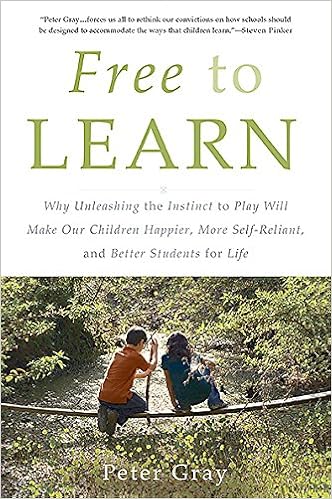
Free to Learn by Peter Gray

Chapter 10 - Trustful Parenting in Our Modern World

"If you want responsible kids, you have to allow them the freedom to be responsible."


In this last chapter, Peter Gray focuses on parenting. He identifies three styles of parenting.

TRUSTFUL PARENTING: Parents trust children to play/explore on their own, make decisions, take risks, make mistakes, learn from their mistakes, and so forth. They do not direct the child's development since they trust the child to direct their own. This is not neglectful parenting; parents provide freedom with sustenance, love, respect, and support for development as needed.

DIRECTIVE-DOMINEERING PARENTING: Parents work to quash the child's will and replace it with a willingness to abide by the wills of others. This style is not very effective and has greatly diminished as a parenting approach.

DIRECTIVE-PROTECTIVE PARENTING: Parents limit the freedom of children because they fear for the safety of the children. They view children as fragile and incompetent. They believe they can make better decisions for the children than children can for themselves. They work to direct the child's development because they feel that adult plans are the best way for kids to develop.

Of course, Peter Gray advocates a trustful parenting approach. Trustful parents communicate to children: "You are competent. You know what you can do and what your limits are. Your opinions count. You are responsible for your own behavior and your own mistakes. We are with you, not against you."

But the North American culture overall greatly underestimates children's abilities and thus deprives them of opportunities to learn to control their own emotions and behavior. The decline of a more trustful approach is due to some changes in the world: decline of neighborhoods and neighborhood play groups so there are more restrictions to playing around the neighborhood; more culture of fear with media and "expert" warnings and dangers; desire to protect children from mistakes and own foolishness; view of childhood as time for resume building instead of playing (to have a more secure adult future); rise of school-centric model of development and the need to conform to mandatory school requirements. All of these can chip away the trustfulness that parents can have in their children.


Ways to become a more trustful parent (and I think these apply to teachers, too)

  • Examine values and how to apply them to children - How can you best build values of responsibility, honesty, self-initiative, etc.? Practice them as adults and help children practice them, too.
  • Accept that children need to take ownership of their own futures without adult control. Adults do not determine or set the child's future and should not shoulder the responsibility to direct the child's development. (This doesn't mean that we don't support development; we shouldn't try to direct it.)
  • Create safe spaces for play and exploration. Trust the child's ability to do his own activities and don't monitor too obsessively. Consider other alternatives to conventional schooling.
This trustful approach has me thinking. Rather than trying to develop differentiated learning experiences within the classroom environment, we should try to find ways to provide a broad space and materials for learning and allow children to direct that learning on their own. I'm reminded of Gray's discussion of the Sudbury Valley School environment. How can we create learning environments that allow children to take ownership for their own learning, responsibility for their own behavior, and ability to make mistakes and learn from them? Some big things to think.

I'll have one more final reflection post on Free to Learn. It's been an interesting read for me.

Monday, January 9, 2017

Play Is Freedom


True play allows children to choose to do or not do, to choose what to do and how to do it. If there's adult direction in any form, it's not really play.

(See posts on Free to Learn by Peter Gray.)

Thursday, December 15, 2016

Things That Have Me Thinking


Throughout this fall, I have been reading the book Free to Learn by Peter Gray. Some of the ideas and concepts in that book have had me thinking. I really like it when someone brings me new ideas or challenges my own ideas, making me rethink or at least examine my assumptions and conclusions.

Here are some posts that have had me thinking in the past couple of weeks. These also connect to play and learning and freedom and independence, so maybe those topics are just catching my attention lately.

Recess Responses: Challenging Five Common Excuses for the Removal of Playtime (Not Just Cute)
I love to read Amanda's blog. Just about every post makes me think. And often she writes what I've been pondering in ways that are much clearer than I could ever write. In this post Amanda takes on some excuses about declining recess in schools.


Here's the Scoop on Crafts Vs Art in Preschool (Teach Preschool)
Deborah reviews her listening to a broadcast on BAM Radio about this topic. Then Deborah thoughtfully lays out her own approach to this in her classroom. Some great stuff in this balanced approach - as always from Deborah.


Brave (Teacher Tom)
Tom reviews his group's use of swings on their playground...and in the process stresses that kids can participate in risky play and know their own limits without a lot of guidance from adults. Tom's writing here connects with some of the things that Peter Gray has written in Free to Learn. (Those reflections coming soon.)


Things Adults Say (Sandy Reads)
Sandy reflects on her recent experiences as a learner and what the teacher has said to her. Sandy writes about how we as adults say similar things to our young students and those kids may not be able to process things in the same way. This makes me think about what I say and listen to myself in the classroom more.


How 4 Words Changed the Way I Talk to My Kids (Not Just Cute)
Amanda (again) writes about changing the use of but in our conversations with kids and what to say instead. Our words are powerful and we must be careful what we say to kids and in the presence of kids. (See my related post Wielding Our Power Carefully.)


The Ultimate Guide to Fine Motor Strength with Recycled Containers (Sugar Aunts)
Using squeeze bottles and water to build hand strength. I loved this simple (and yet not so simple) idea...and it recycles/repurposes things, too!


What's inspiring you?

Tuesday, December 13, 2016

Shapes and Nativity Patterns

This group of kids keeps me guessing. They don't really do art. They love to do blocks. They do like games. Some of them like to do anything with others. A couple like to do things alone. But we are learning that they need time - time to do some familiar things and then explore the rest of the activities.

Cindy found some nativity patterns at This Reading Mama. We printed them and put them out with our magnet shapes.


After a little while, kids decided to explore the shapes. Some worked hard to match the patterns.


Some explored the shapes and patterns in their own unique style.


I even worked on one a little.


The boys wondered about the "profile" king and his one arm. So they decided to create more arms for him. (I think at one point he had almost 20 arms in various places on his body.)


By the time my boys were really engaged in this, our time was running out. I'll put it out again this week and maybe they will get into it more quickly.

Or - as this group has shown me - we may do something else completely different.


P.S. Here's the link again to the free nativity patterns we used. They are from This Reading Mama. I have no affiliation with that blog - we just liked and used the patterns.

Friday, December 9, 2016

Freedom to Choose and Freedom to Use


As I read through Free to Learn, I keep finding words that explain my own thinking. Or at least Peter Gray has said things that I've always wanted to say but didn't really have the words to do so. One of those things that he has repeated in the chapters I've recently read is that play is freedom. He stresses the freedom to quit (to decide when to stop doing the activity). But I think that the freedom to use whatever resources are needed is important, too.

I'm a big advocate of children's creativity. I encourage children to follow their ideas and experiment with materials. And a few years ago, we adopted a "rule" to provide resources for a child when he asks for it, if possible. If a child asks me for tape or scissors (and those items are not already out in the room somewhere), I get them for him. I want to provide the tools for his creativity.

Often in my room, scissors, glue sticks, and paper scraps are always available if needed. I found some of those magnetic locker "baskets" (cheap at the back-to-school sale) and attached them to my white board. Kids can use these items whenever they choose; the resources are always at hand. (Not a new idea, I know. But it was a new step for us.)


I worried that I would be cleaning up paper bits each week from overuse of scissors. However, kids only use them when they really need them...which is not very frequently. And when they are used, the results can be surprising and amusing.


Since my room is used for a variety of other groups of various ages, I have to keep things easy to put out and take up. One day I hope to have a situation in which I can leave out more art supplies to be used as the child chooses. Until that day, I'll facilitate as much as possible...and enjoy the results.

But I'm learning that this availability issue isn't just art supplies. This year I have a boy that wants to use the cars often in the blocks center. The cars stay at my house unless I'm planning on using them. (We don't have the storage space to keep lots of supplies in the room.)


My friend has asked for the cars a couple of times and I bring them the next week. But recently I decided this wasn't enough. So I got a small container and filled it with some of our cars. I keep them in the cabinet in the room. When my friend asks for them, I pull them out for him to use.

Keeping scissors or cars available may seem inconsequential. But allowing kids the freedom to choose and the freedom to use what they want is huge. Following ideas through play and exploration helps children learn what they need to learn. (And when they need to learn it.) Don't dismiss engagement and high interest. Those can be the times that kids can learn the most (even if it's not what I planned for them to learn.)

Providing materials as requested also gives children some ownership in the learning environment and in the learning itself. And that's what we really want in the long run--children invested in their own developing understanding of the world. Those scissors or cars (or whatever) aren't just toys or materials - they are tools for exploration.

Kids should have the freedom to choose - and use - the tools they need and not just the tools I think they need.

Saturday, December 3, 2016

My Kids Don't Do Art

Now, if you know anything about me as an early childhood teacher, you know that I think choice is important and that I want kids to follow their interests. We often have activities that have little or no interest on a particular day. And that's fine.

But this year I've noticed something interesting about my little group of kindergartners in my church kindergarten class. They are not really all that interested in using art materials.


I often have no one go to the art table to even check on what's there. For the first few weeks, we had out painting every week. No one painted.

My group likes to be creative in many other ways. They like to explore blocks and build interesting balancing towers.


They enjoy playing games together. One day we played a counting/math game over and over and over.


They enjoy working puzzles. And even trying to work them out of the frames.


They do like to write sometimes. Or draw. So the writing center gets some attention from time to time.


But the art table is often neglected. And when they do go there, they like to do it as a social activity. They will talk and interact with one another or enjoy an activity that is more cooperative in nature.


Having a group that is less interested in art means that I plan in different ways.

1. We still have an activity at the art table (even if no one does it). It's important to provide that option every week. You never know when a child will need that outlet. Or if something happens in the room that leads a child to go to the art table.

2. Sometimes an art activity will be available for two weeks instead of just one. If no one does it, I may not plan a new one for the next week. The previous one makes a return appearance, just in case someone decides to choose it. (But after two weeks, something new appears.)


3. I make sure to tell my kids what's at the table. They often head directly to blocks or games and may not look at the art table on their own. I will tell them what's there in case it sounds interesting to them. (I have done this in the past, but it seems more necessary with this group.)

4. If we are doing a painting activity, I don't pour out paint until someone is ready to do it. I have washed some paint down the sink by putting out a pan of paint that no one uses.

5. My activities are less elaborate but still engaging.

6. I look for ways to include some options for art sometimes in other centers (like blocks or dramatic play). By including art in areas that seem more engaging to this group, I increase exploration opportunities.


Each year I learn something new (or am reminded about something) regarding teaching young children. This year my group is reminding me that it's okay if something isn't done in the room. And that the room should be about them and not about me or a preconceived idea of what activities should be done.

My kids don't really do art. But they do create and they do learn.


Thursday, November 17, 2016

The Yard Sale

I honestly don't know why people want to spend time with adults and not young kids. I always have a fun and interesting time, with intriguing conversations. And I am continually surprised by them. (Well, adults surprise me, too, but in completely different and often less positive ways.)


We put out the doll furniture with the wooden blocks. Since we were talking about families, I thought the kids may build rooms or houses and use the furniture. At the very least, the furniture could trigger conversations about homes and families.

One boy came to the center. We talked about the fact that there was furniture there. He pulled all the pieces out and placed them on the floor. He moved them around a little - then he declared, "Oh, it's a yard sale." 

He arranged the pieces in various configurations until he was pleased with the display. We continued to talk about different things--the furniture and yard sale, other things that he was thinking, maybe a few things I was thinking. He picked up one piece. "The stove is sold," he told me as he set it aside, "for $150." 

"$150? That's good," I said.

Then he picked up the couch. "The couch is sold," he said. "$60,050."

"Wow," I said, "that is a lot of money for a couch."

"Somebody paid it," he said. (I had no comment to that.)


Even after...all...these years of teaching kids and working with them, they surprise me. That's why I try to stay out of their way. I have idea when I plan the classroom activities and put out resources. I know what I think may happen. But I always try to communicate that the kids can use their own ideas. I learn about them and their thinking as they build or draw or play.

If I'm not open to new ideas and directions from the kids, then I'll miss the surprises and insights that I can learn.

The yard sale play went on for a while. Then the boys were off to paint or something else. Others came and moved some of the furniture around. Some pushed it aside to build with blocks. (Not rooms or houses but towers.) That's the nature of the classroom.

But I'll always think of the yard sale when I put out this furniture. And I'll handle that couch with a little more respect. After all, someone paid thousands of dollars for it.

Friday, October 7, 2016

Exploring and Discovering

Each week in my classroom I carefully choose materials to place in each part of the room. I have an idea of what the children may do with the materials. Of course, we must always allow for the ideas of the kids, too. Right?

The kids in my classroom now are reminding me that the joy of learning is the doing - the exploring and discovering. They take what's there and do what they want with it. (Nothing inappropriate, usually.) Here's what happened a couple of weeks ago.

I put out our cars (at a child's request from the previous week) and black paper strips (for roads). These were added to the blocks center. When the first child came to the center, I pointed out the black strips and commented they were available for roads or whatever.

He began to build. He made a few roads. Then he made roads that went over the blocks.

Cars and Roads (Brick by Brick)

He tried different variations of road strips and blocks. He drove his car on, over, and around. The car even had an unfortunate leap from the top of a building.

I had never thought about putting the road pieces on the blocks. But he did. In exploring the materials in different ways, he was discovering something new. (And so was I.)

Later, a couple of other boys began lining up the cars, one behind the other, across the area.

When I saw it, I just watched for a while. I commented, "You are putting the cars in a line."

"Yes," a boy said. "This is traffic." (And it does look like Nashville traffic does at times.)

Cars and Roads (Brick by Brick)

"I see," I said. "I think I've been in traffic like that before."

"We were," he said. Then he told me a story about his family from the past week.

He was exploring what had happened to him and processing it. He was discovering more about driving in a big city with lots of traffic. (Sometimes it's frustrating and you're at the end of the line.)

In another area of the room, we had mirrors and dry erase markers. I planned for children to draw and write on the mirrors like dry erase boards. That did happen.

Mirrors and Dry Erase Markers (Brick by Brick)

But later another child wanted to explore the mirrors further. She walked around the room and looked at different things in the reflection. Then she added a mirror to our writing box. Soon another mirror appeared there, too.

Mirrors and Dry Erase Markers (Brick by Brick)

She was exploring mirrors and what the room looks like in it. She was discovering more about reflection and light and artistic expression.

I'm committed to allowing exploration - allowing kids to try things in different ways - to do things "just because." In doing so, they are discovering what they need to know about the world.

And teaching me a few things, too.

Friday, May 13, 2016

Wasting Paper

I had to stop myself the other day. I had put out paper and scissors and glue sticks and punches. My plan was for the children to explore with the materials. I had a vague idea of "making cards for others," but even that was just a vague idea.

After all, the "rule" in my classroom is to use the materials to express your own ideas. A few weeks ago we explored punching holes as a new skill. So that's why I was at this point. We added some shaped punches to explore that idea and had scissors because - well, who doesn't like to cut up paper?


As they began to explore, I found myself thinking, "They are wasting paper. They punch one or two holes, they cut a large loop around the paper, they toss paper aside. Waste."

I almost said something aloud to them, but I didn't.

I watched. I commented or narrated occasionally. I let them make choices about what to do and how to do it.


And I realized that, yes they were "wasting" paper - no real concrete product was achieved. In fact, I'm not sure many took anything home that day.

But they were not wasting paper because they were learning and discovering more about what they could do, what the tools could do, and how they could manipulate paper to be what they wanted. Those are all great results from this exploration.


And the paper? Some I could salvage for the scrap box and another day. Some I tossed. But either way, the paper didn't care.

But the children did. They loved it.

Tuesday, December 1, 2015

Expand the Possibilities

A few weeks ago, I blogged about kids using our "make your own roadway game" pieces. Recently we were using them again. Boys came to the table and looked at the pieces. They arranged them into a trail and played the game.

gameboard (Brick by Brick)

I talked briefly with them and then moved to kids at the art table that needed my attention. I noted that the boys completed their game and then were rearranging the pieces to play again.

"Can we put this on the floor?" one asked. I said yes.

So they began to build a new gameboard.

gameboard (Brick by Brick)

They built and built.

gameboard (Brick by Brick)

And they played the game....

gameboard (Brick by Brick)


gameboard (Brick by Brick)

At some point, the long trek became exciting. I heard at least one of the boys shouting when he rolled the cube and moved his piece. Then he shouted when the other boy moved his piece.

gameboard (Brick by Brick)

Other kids gathered to watch the end of the game. There was practically a cheer when they reached the end.

gameboard (Brick by Brick)

I continue to be reminded and surprised by the power of yes ("Yes, you can put that on the floor instead of on the table where it was intended.") The kids have enjoyed this game. But, somehow in this particular moment, expanding the game through the blocks center created an entirely new experience.

The power of yes encourages kids to explore their ideas and expand the possibilities. And makes one long gameboard.

(I blogged more about this on the EdWords blog. Check it out.)