Showing posts with label educational issues. Show all posts

Tuesday, November 15, 2016

Children Educating Themselves


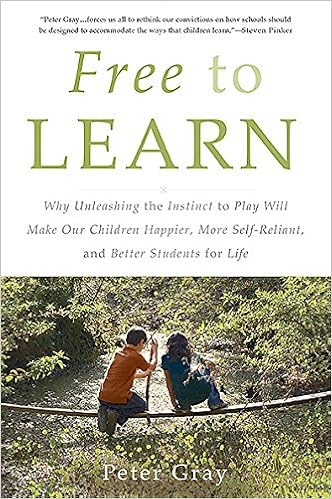
Free to Learn by Peter Gray

Chapter 5 - Lessons from Sudbury Valley: Mother Nature Can Prevail in Modern Times
"People naturally want to make sense of their world."


In chapter 5, Peter Gray explores the Sudbury Valley School, founded by Daniel Greenberg and others. Greenberg had wondered, "What is wrong with our educational system that prevents students from developing passionate interests and then pursuing those interests in their education?" He founded the school to create a democratic institution in which students could pursue their own interests and come to their own conclusions.

I found the description of this school very interesting. The school is administered by the School Meeting, with every person in the school (students and adults) having one vote in the proceedings. The meeting discussed and decided all rules of behavior, hiring decisions, budget and expenditure decisions, and so forth. The rules are enforced by a Judicial Committee comprised of student representatives and one staff member.

Students move freely throughout the grounds all day and associate with anyone they choose. Staff are adults that serve as resources and do other appropriate work (including ensuring safety and giving comfort as needed). Students can use whatever resources are available onsite as they choose - books, computers, equipment, adult staff, and one another. (Students must be "certified" to use expensive or dangerous equipment; they receive training as needed and show proficiency before they can use on their own.) Classes in specific subjects are offered at students' request and last as long as interest continues. Students older than 8 can leave the campus anytime; under 13 must be accompanied by another student and sign out. No set scheduled or set classes/subjects. Students are not grouped by age or in any other way (except as they choose). The school has no established curriculum, no testing, and no student ranking. If students want to receive a diploma, they prepare and defend a thesis explaining why they are ready to graduate and how they are prepare for responsible adult life; this is evaluated by outside reviewers.

"The basic premise of the school's educational philosophy is that each person is responsible for his or her own education."

Through this example, Peter Gray concludes that these conditions optimize children's abilities to educate themselves effectively--

  • Time and space to play and explore (unscheduled time, space to roam, choose for themselves)
  • Free age group mixing
  • Access to knowledgable and caring adults
  • Access to equipment and the freedom to play with it
  • Free exchange of ideas (all ideas are on the table)
  • Freedom from bullying (a safe environment)
  • Immersion in a democratic community

I'm very intrigued by the idea of the Sudbury Valley School. I agree with the basic premise that each person is responsible for his own education. I think that kids need more freedom to choose and pursue their own ideas and interests with less constraints. I think that many adults feel a need to exercise more control than they need to do.

I'm unsure that this philosophy could be replicated on a large scale throughout the country. But I do think that the education system could incorporate more of those conditions above and create environments that allow children to educate themselves more. I also think that we as a nation need to think about approaching education in some different ways, not just tweaking the existing system but creating a new one.

Kids want to explore their world. They are born ready to do it. We just need to find ways to get out of their paths.

Saturday, October 22, 2016

How Did Our Schools Get Here?


Free to Learn by Peter Gray

Chapter 3 - Why Schools Are What They Are
Chapter 4 - Seven Sins of Our System of Forced Education

"Children's instincts for self-directed learning can work today as well as they ever did."


Peter Gray offers a brief history of our educational system. He says that education and schools today are a product of our history. As cultures turned to agriculture, children were expected to do more work to support and help the family and had less time for self-directed exploration and play. Values within the system shifted to see work as more desired and play as wasteful use of time. Feudalism and industrialism created power structures from the top down and those in lower ranks were more dependent on the powerful. This was imparted to children as well.

Education grew from religious institutions, with the primary method of instruction as rote memorization. Hard work was emphasized and valued. "Learning was understood to be work, not play." Later the government took over education. "Schooling came to be seen as a state function that was essential for national security...", shaping future citizens. Education became compulsory and more standardized (in both content and method). These concepts of education continue down to the present-day. "We automatically think of learning as work, which children must be forced to do in special work places, schools, modeled after factories," writes Gray.

He lists seven sins of the system of compulsory ("forced") education:
  1. Denial of liberty without just cause and due process.
    (Should children be required to attend school?)
  2. Interference with the development of personal responsibility and self-direction.
    (We assume children are not able to be responsible for their own education due to their age. Schools do not allow children to self-direct their education or assume responsibility for it.)
  3. Undermining of intrinsic motivation to learn (turning learning into work).
    ("Anything a person is forced to do, according to someone else's schedule, using procedures that someone dictates, is work." Schools circumvent the child's natural tendencies to learn and explore.)
  4. Judging students in ways that foster shame, hubris, cynicism, and cheating.
    (Continual testing creates inferior and superior feelings in students; focus on grades and no real focus on actual learning; pressure to perform)
  5. Interference with the development of cooperation and promotion of bullying.
    (Schools force competitiveness on children and promote selfishness. Lack of age-mixed play discourages cooperative and nurturing among students.)
  6. Inhibition of critical thinking.
    (Grading is powerful force against honest debate and critical thought. Focus on correct answers to other's questions rather than own thoughts and questions. Increased anxiety inhibits playfulness and critical thinking.)
  7. Reduction in diversity of skills and knowledge.
    (On their own, children follow diverse paths and unpredictable connections in education; but in prescribed curriculum, no room is allowed for a child's own interests. Schools don't adjust to different personalities; they try to mold students to fit the system.)

These two chapters did provide some insights into our current approach to educating children. I agree that schools provide little in the way of diverse approaches to education. That goes for teachers, too. Sometimes it's hard for teachers to deviate much from the norm; the pressure to do it the "right" way is often very real. 

It seems that, in the current climate, the tendency is more standardization, more testing, more "work" for students. More hoops, more data, more directives for teachers. I have heard people say that we cannot fix our current system; the only way we can change what's happening is to start from scratch with a new system. That seems to be where Peter Gray is going, too.

I am interested to see where the book will be going next. Peter Gray certainly writes with a specific point of view...and I wonder how his view of things will align with my own.

Saturday, September 10, 2016

The Worst Thieves


Today I was reading through blogs and email newsletters and other things. I saw something and it will not let me go. I keep thinking about it. Austin Kleon posted a link in his newsletter. He's not a teacher but an author. But what he posted is - to me - a huge commentary on education.

His link was a photo of a poster that protested children working in textile mills. The caption on that quote is--
The worst thief is he who steals the playtime of children. (W.D. Haywood)
 I stared at this quote. Later I read it to my wife and showed it to her. If I ever write a book about play or young children, this quote is going in it.

I think this is where our education system has been in recent times. Leaders are stealing the playtime of children. Stealing it from the classroom. Stealing it from recess. Stealing it from home. Stealing it younger and younger.


Overall, I see this happening more and more. Academics being moved down the grades. When what really should happen is play and investigation and exploration moving up the grades. As David Elkind says: "Quality early childhood education should be the model for education at all levels."

But I cannot cast the "thief" label without caution. I, too, sometimes steal the playtime. I have agendas or goals. I have planned investigations that are led by me. I push what I think should happen over where the children's play wants to go. Am I stealing playtime (and valuable learning experiences) from children?


Let's look for ways to give playtime rather than steal it away. After all, that's when the real learning happens - play directed by the child to investigate what he is thinking.

The quote above is going to join my recent list of memorable ones. And here's another one from Rae Pica: "I shouldn't have to defend play for children any more than I should have to defend their eating, sleeping, and breathing."


We shouldn't need to defend play. And we shouldn't need to keep it safe from thieves. Let's just get out of the kids' way.

Monday, June 20, 2016

All Ages Should Play

from The Power of Play

Schools for all ages should include curriculum and methods that incorporate students' interests, needs and abilities; students should be able to choose projects that challenge them to investigate and develop appropriate knowledge and skills. (See more here.)

Friday, June 17, 2016

Early Childhood Education Should Be the Model

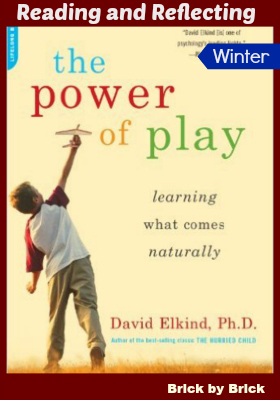
I am reading and reflecting on the book The Power of Play by David Elkind.


Chapter 9 - Schooling with Heart, Mind, and Body


In this final chapter of his book, David Elkind thinks about education in light of our current cultural climate. Or at least he thinks about it in the climate in which he wrote the book. This book was written before tablets became ubiquitous. But he still talks about how technology has and is changing the classroom. Many students and families have easier access to information and more opportunities to respond and create (instead of just consume information). Teachers are more facilitators and guides instead of givers of information.

Elkind sees the current atmosphere in education as a reinforcement of Dewey's ideas--education should be functional, practical, related to what students need to know or do in the "real world." He notes that Dewey's ideal was the project method of education, one in which students bring together different skills and knowledge to complete a meaningful project. Elkind's thinking here dovetails with the maker movement and genius hour and creativity and other current trends and topics in the current education discussion. "Dewey's project method," Elkind writes, "combines creativity, self-motivation, and practical learning--play, love, and work. Such education is effective because it addresses the chid's heart, mind, and body."


Elkind also notes the inertia in our current education system. Through choice or circumstances, through other priorities or misguided thinking, many schools and educators do not embrace our new reality. They hold on to methods from earlier eras (memorization, rote learning, acquisition of information) rather than allow technology to serve a tools for these things.

Then Elkind wrote what is, to me, a key statement. (I love it so much, I'm setting it off on its own.)
"Of all the educational models, the early childhood model is the one that is most in keeping with the new reality.... Although it seems counterintuitive, quality early childhood education should be the model for education at all levels."

Instead of a factory model, inputting information to the blank minds to get the desired final product, schools of all ages should include curriculum and methods that incorporate students' interests, needs and abilities; students should be able to choose projects that challenge them to investigate and develop appropriate knowledge and skills. Elkind writes, "When children have a say in their learning, they are much more excited and involved than when they do not."

But our current system isn't doing that on a large scale. In fact, just the opposite is trying to happen - many are trying to push the factory model into early childhood education. "Those who are willing to look an see that the early childhood model of education is best suited to meet the new educational reality. This is what makes contemporary efforts ti impose the factory model of education onto preschool pedagogy such a travesty. Quality early childhood education is effective because it integrates play, love, and work."


I think we need less "academics" and rigor in early childhood education and more play and exploration in primary and secondary education. Let's start pushing up instead of pushing down.

Since we're not there yet, Elkind recommends that teachers incorporate playfulness and creativity into the activities (to combat the outmoded system). Games, open-ended question, challenges, activities/projects that cross disciplines - all of these can help add a little play in any grade level's learning time.


"It is when all three [play, love, work] are brought together that children have the best chance of learning in the context of their unique personal circumstances."

This book has stimulated all kinds of thinking for me - maybe more of a gathering of threads or consolidation of concepts rather than new ideas. I'm reflecting a little more and will post a final reflection next week. (Bottom line - I recommend this book!)

Monday, May 30, 2016

Education and Measurement

@BreneBrown           BAM Radio QuotED

So much of what kids are learning cannot be measured. Understanding builds a foundation but doesn't translate to standardized testing easily. Compassion, creativity, confidence, and cooperation defy most assessments.

What we measure becomes "priority," but that doesn't mean that it really is important.

Tuesday, February 16, 2016

No Live Plants

I had another Rae Pica moment. I know it sounds like I'm using her name in vain, but I'm really not (or at least that's not my intent). After reading her book and seeing her #AskingWhatIf posts, I always think of her when I run into things that just seem incomprehensible or over-reactive in education settings. (Rae, if you want me to stop using your name, please tell me.)

A friend commented that her husband sent her fabric roses for Valentine's Day since the school does not allow any live plants or flowers. That washed over me for a minute. Then I had a mental double take. What? No live plants?

The reason? Allergies. I understand the need to keep kids safe and avoid things that could cause concern. But no live plants? I have so many questions.

How can kids explore and understand plants and how they live?
What about science exploration?
Do kids ever get to go outside, where live plants are everywhere?
Or is the "landscaping" around the school just concrete?
What happened to using the senses to investigate the world?
Can kids plant seeds and watch them grow?
Can they go to a pumpkin patch or orchard for a field trip?

I know, I know. Allergies. But surely there's another way to address these needs without totally banning the natural world.

Thanks, Rae, for making me be in tune with these things. And for keeping me asking "What if?"


**Note: I am not trying to be unkind to any school, leader, or administration. But I don't think many leaders nowadays are truly thinking through implications of the "easy way out."

Friday, February 5, 2016

Homework in the Snow

View from my office during the snow days
A couple of weeks ago, we had snow. (Like many others in the country.) A lot of snow. Well...a lot of snow for us. So school was out and many businesses closed.

Snow's a big deal here. We don't get it very often and we don't handle it well when it comes. Actually, we may handle it in the best way - we stop everything and just enjoy it. We play in it. We stay put. We use the bread and milk that was frantically purchased before the snow fell. (Don't ask me why we always buy these things. You just do it when it snows in the south!)

While surfing Facebook on one of these snowy days, I came across a post from the wonderful Rae Pica. (If you don't follow her, you should. She's always posting great stuff about kids and early childhood development.) The article ("nonsense") she posted told of schools that give homework for snow days - to combat the learning "amnesia" that could occur during the time off from school. What?!?!!

(Caution: Possible rant ahead)

Why don't we trust kids? There's mounds of snow outside. They are going to go out and explore it. They will actually "learn" something, too. They will have firsthand experiences with the cold, wet, slick stuff. They will figure out trajectories as they lob snowballs at one another. They will discover negative space as they make snow angels. They will delve into engineering and construction as they create snowmen. They will PLAY.

This is especially true in places similar to where I live. We get snow so seldom (and often tiny bits when it does come). This is the perfect time to explore. Oh, we can talk about snow and its characteristics. We can look at pictures of it. We can analyze it from an intellectual perspective. We can create small bits of it to handle. But nothing beats tromping through it on an icy cold day or scraping it from the hood of the car to really understand what it's all about.

A kindergarten teacher here also gave snow day homework. Actually she challenged her class to a Snowman Competition. She sent a message to each of her kids, challenging them to build a snowman and send her a picture of it. She planned to share them with the class when they returned to school. This wasn't in her lesson plan. It wasn't strictly assessed. But I think it's a great idea! She picked up on what was happening in the children's lives and brought it into the classroom in a way that was fun, connected, and meaningful.

I fear our system has moved into a dangerous direction. Are we are more concerned about kids forgetting something that they "learned" in school because they are playing in the snow than encouraging them to enjoy what's happening outside their own doors? (Side note: If they forget it that quickly, did they really learn it?) We seem to be emphasizing knowing things over living life. Hmm. Not what I hope for the future leaders of our society.

Let them play in the snow. Yes, they may learn something. But they will have fun. And that's okay in it's own right, too.

Wednesday, January 27, 2016

From Standardization to Personalization

I have just finished reading Creative Schools by Dr. Ken Robinson and Lou Aronica. The book has lots of things to think about. A main focus in the book is developing ways to make education more personal and connected to each individual student.

Toward the end of the book is a long quote from Jimmie Don Aycock, a Texas state representative. Here's the end of his quote:
"[Some people] felt that if you test students more, raise high standards, and keep the pressure on, we will excel and move forward in our educational results for children. I've got to admit that there was a time that I felt that way. The thing we missed in that thinking was that that's a nice mechanical view of education. It's like a factory-production view. What that fails to take into account is that human beings are not all alike. You can do the same thing and get very different results sometimes. So I backed away from that thinking and I realized that No Child Left Behind is left largely on that kind of thinking and I just don't believe that anymore."
A lot of what Ken Robinson has written addresses the need to change from this production line, everyone is alike culture to a more diverse, organic culture. The metaphor needs to change from industrial to agricultural. Teacher Tom has addressed these same concerns. I've seen school curriculum that assumes all students are the same and evaluate their work with little regard to individual development or background.

I hope we get to the point where interest and individual development and needs and strengths all have input in how we teach and what we value. (Yes, value. What we test and emphasize is what we value.) Telling a great story or drawing an insightful picture are important, valuable skills -- just as valuable as reading difficult words or reasoning through a math equation.

I love to use play, exploration, and investigation because kids can enter into experiences in their own ways, use their own strengths, gain support from others in non-threatening ways, and develop understanding through individual perspectives. Is play a cure all? No. But it does recognize individuality, much more than many strategies in the classroom today.